May 15, 2026 · 7 min read
How to Read a CBP Bill of Lading: A Buyer's Field Guide
Ocean Bills of Lading aren't what most US-Mexico produce buyers actually receive. Here's how to read both — the BoL and the Pedimento that replaces it for trucks.
If you're trying to read your Mexican supplier's truck shipment record, you're not looking at a Bill of Lading. You're looking at a Pedimento + Carta Porte. The "BoL" framing — copied from generic supply-chain content online — applies to ocean freight under maritime law. For 62.5% of US produce trade by truck, the actual document is something else entirely.
This guide walks the ocean BoL field by field with a real redacted Ecuadorian pineapple sample, then pivots to the Pedimento that Mexican-truck buyers actually receive — using a real Tommy Atkins mango sample to show every field, including the Mexican régimen aduanero codes, the fracción arancelaria HS classification, and the Carta Porte transport document that operates parallel to the customs declaration. The goal: you finish this post able to read whichever document your supplier hands you, and you don't conflate them.
What Is a CBP Bill of Lading?
A Bill of Lading (BoL) is the legal document governing ocean freight — issued by the carrier (steamship line) to the shipper, filed via the Automated Manifest System (AMS) under the post-9/11 24-hour rule, and operating under the Carriage of Goods by Sea Act (COGSA). In Spanish trade language it's the Conocimiento de Embarque; in everyday Mexican-export commerce most operators just say "BL" or "Bill of Lading" as a borrowed term.
The BoL has three legal functions, each of which matters in trade disputes:
- Receipt of cargo — confirms the carrier received the goods in apparent good order
- Contract of carriage — sets the terms under which the carrier will transport the goods
- Document of title — possession of the original BoL is required to claim the goods at destination (this is the function that makes BoL different from any other shipment record)
- BL Number is the carrier's unique tracking ID for the cargo. Every cargo movement under that BL is the same shipment. Steamship lines prefix BLs with the carrier code (here, "028" — Maersk-prefix conventions vary by carrier).
- Shipper / Consignee identifies the legal counterparties — the foreign exporter and US importer of record. The shipper signs the cargo onto the vessel; the consignee takes legal possession at the destination.
- Port of Lading / Port of Unlading are the foreign and US ports for the actual sea transit. Note these are vessel ports — not the inland packing house or the inland US destination warehouse. Guayaquil is Ecuador's primary Pacific export port; San Diego is the US West Coast unloading port. From there, the cargo enters US distribution by truck.
- HS Code (0804300000) is the 10-digit Harmonized Tariff Schedule classification for "Pineapples, fresh or dried." See our HS-subcode discussion in the lime cultivar post for how these codes work.
- Description is free-text product description filed by the shipper, typically in the local language. "Caja de piñas" = "boxes of pineapples."
- Gross Weight is the cargo plus packaging weight in kilograms. For reefer cargo, comparing gross weight to the 40-ft container nominal capacity (~24,000 kg max for fresh fruit) tells you container utilization — a partial-load container vs full-load matters for freight cost allocation.
- Origin Country confirms where the goods were grown and packed.
- Invoice Value is the commercial invoice amount declared for customs valuation.
- Vessel name is absent from our vendor feed. The BoL legally requires it; the public-facing CBP AMS extract typically redacts it for vendors. ImportGenius / Panjiva / Datamyne show it through different licensing arrangements.
- Container number is similarly redacted from our feed. Same caveat.
- Notify party is rarely populated and often duplicates the consignee.
- Marks of identification (the markings stenciled on cartons for warehouse routing) and number of packages are absent from our feed.
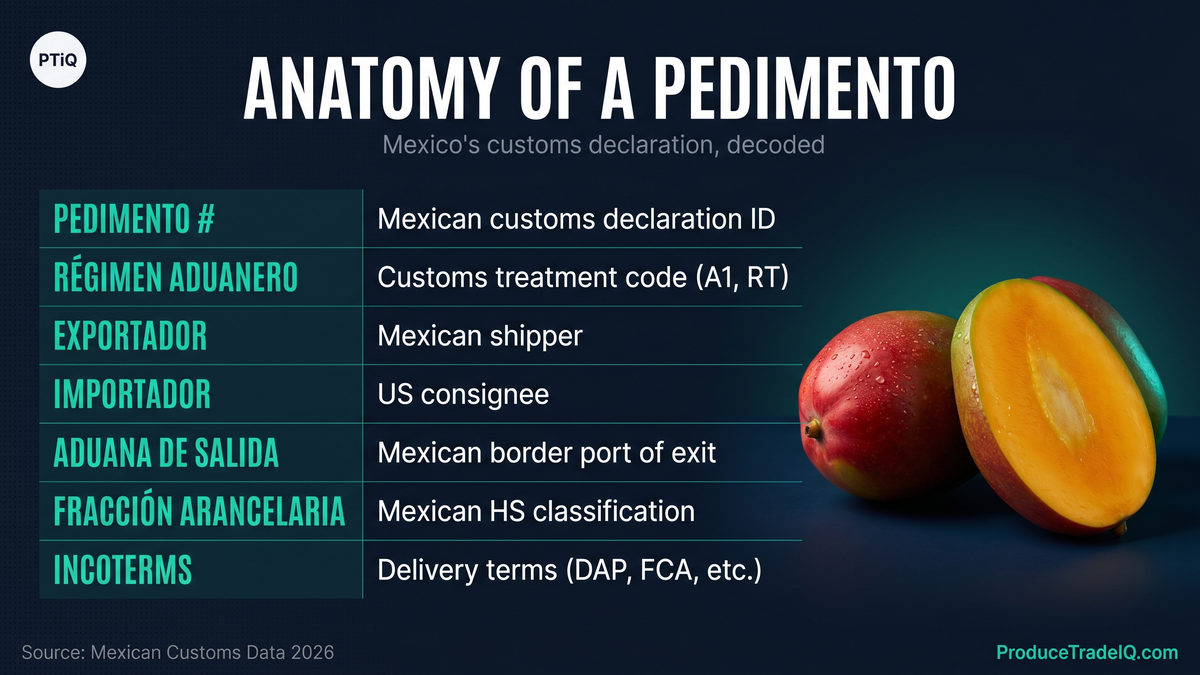
- Pedimento # is the Mexican customs declaration's unique ID. Filed by the Mexican licensed customs broker (agente aduanal) at the Mexican border before the truck physically crosses. 11-digit format; the prefix encodes year + customs district.
- Régimen Aduanero is the customs treatment code. Two régimen codes cover 99.97% of Mexican produce truck records: A1 (definitive export, 77.4%) and RT (return of merchandise under IMMEX, 22.5%). RT shows up when the Mexican exporter is operating under the IMMEX maquiladora program — typically because they imported inputs (seeds, packaging, agrichemicals) under IMMEX and are now exporting the finished product. For US produce buyers, both codes mean the goods are on the truck and headed to your warehouse.
- Aduana de Salida is the Mexican border port of exit. Ciudad Reynosa is the Pharr-Reynosa International Bridge crossing — the dominant produce corridor (62.5% of Texas produce). See our Texas border crossings guide for the full Texas port mix.
- Exportador / Importador are the two trade counterparties. Note the legal classification — Mexican shippers can be corporate (SA de CV, SPR de RL, SAPI) or persona física (individual). The onion and watermelon posts both surfaced strong persona física patterns in their respective top-10 exporter lists.
- Fracción Arancelaria is the Mexican TIGIE 9-digit HS code, finer-grained than the US HTS 10-digit. Lime is the only commodity in our May arc data with hardcoded cultivar separation at the HS subcode level — see the lime cultivar post for how that plays out.
- Producto is free-text product description in Spanish. "MANGO TOMMY" = Tommy Atkins mango cultivar. Useful for variety identification when the HS code alone isn't specific.
- Peso Bruto / Cantidad — gross weight in kg plus secondary qty unit (BOX, PCS, etc.). 25,088 kg ≈ one 53-ft refrigerated trailer at full load.
- Valor MXN / USD / Tipo de Cambio — invoice value in pesos and dollars with the conversion rate. The MXN is the legally-binding declared value for Mexican customs; the USD is the converted value.
- Incoterms — the delivery terms. Our FOB vs CIF post argued that Incoterms FOB is rare for Mexican truck trade. The data: 133 records of 105,172 — 0.13%. DAP (47.6%) and FCA (17.6%) dominate. FOB is essentially a rounding error for Mexican land-truck commerce. The DAP designation on this record means the Mexican exporter delivers to a named US-side place at their cost; from there the importer takes over.
- Ocean BoL data — three options. CBP FOIA office returns raw AMS extracts (free, 60-90 days, unindexed CSV). ImportGenius / Panjiva / Datamyne sell indexed AMS-derived data ($1,000+/month for produce-relevant access). ProduceTradeIQ aggregates BoL records from licensed CBP-derived vendor feeds with produce-specific filtering.
- Pedimento data — your Mexican customs broker (agente aduanal) provides original Pedimento PDFs on request for any shipment they cleared. Aggregated platforms (billofladingdata.com vendor feed, our backbone) license Pedimento at scale. The platform's Competitor Intel and shipment records features expose this without DIY broker calls.
- Carta Porte — your carrier provides the CFDI file directly. If you don't have a carrier relationship, your customs broker can usually pull the Carta Porte from the carrier as part of clearance. Not typically aggregated by trade-data vendors.
- ABI/ACE entry data — your US customs broker. CBP FOIA also possible but slower than the broker path; brokers typically can pull the entry summary same-day.
- "BoL" colloquially means any shipment record in casual trade conversation. In customs / legal context, it specifically means the maritime ocean-freight document. When a counterparty asks for "the BoL," confirm whether they mean the legal ocean BoL or the colloquial "shipment record."
- Truck shipments use a manifest (US-side) or Pedimento + Carta Porte (Mexican-side) — calling these a "Bill of Lading" creates legal confusion. The Mexican exporter's customs broker doesn't issue BoLs; they issue Pedimentos.
- Air shipments use an Air Waybill — distinct legal status (no document of title, which means an AWB cannot be used as collateral or transferred to claim cargo the way an original BoL can).
- Rail shipments use a Railway Bill of Lading — separately governed under the Carmack Amendment (US rail) or Mexican rail-specific regulations. Not the same as ocean BoL.
- The platform's data label "bill_of_lading" is the carrier-issued ID, present on sea-mode records (zari_shipments). Mexican-truck records (mx_shipments) carry a declaration_number — the Pedimento ID. Different fields, different documents, different systems.
The BoL applies to sea freight only. Air freight uses an Air Waybill (AWB), which is a receipt and contract but not a document of title. Mexican-side land freight uses a Pedimento (the customs declaration) plus Carta Porte (the transport document). US-side import filing uses ABI/ACE entry summaries. None of these are Bills of Lading. Calling any of them "the BoL" creates legal confusion in disputes.
For the system context behind AMS — how the four CBP-related filing systems differ — see our CBP AMS data explainer. This post focuses on the documents themselves.
Reading an Ocean BoL: Field by Field
Here is one redacted ocean BoL from our platform's sea-mode feed — the same Ecuadorian pineapple shipment used as the CBP-AMS post sample (narrative continuity):
| Field | Value |
|---|---|
| BL Number | 028-XXXX601 |
| Shipper | [Exporter B] (Ecuadorian pineapple grower) |
| Consignee | [Importer A] (US importer of record) |
| Port of Lading | GUAYAQUIL - MARITIMO (Ecuador's main fruit-export port) |
| Port of Unlading | SAN DIEGO (US West Coast unloading port) |
| HS Code | 0804300000 (pineapples, fresh or dried) |
| Description | CAJA DE PINAS (= "boxes of pineapples") |
| Gross Weight | 19,350 kg (~80% of one 40-ft refrigerated container) |
| Origin Country | ECUADOR |
| Invoice Value | $11,250 USD |
| Transport Type | sea (= AMS-equivalent record) |
| Shipment Date | 2026-02-24 |
Field by field:
A buyer reviewing this BoL knows: who shipped, who bought, what variety/category, what port routing, what container utilization, what cargo value. That's the BoL intelligence layer.
What's Missing from Public BoL Data
Honest disclosure of what our platform's BoL data does not carry — same gap-disclosure pattern as the CBP AMS post §7:
We focus on buyer-supplier relationships and route-level intelligence, not vessel tracking. Different tool, different job — if you need to know which specific Maersk reefer is sailing right now, the carrier portal and ImportGenius are the right tools. If you need to know what your competitor imported from which Ecuadorian shipper at what value, the platform's BoL feed is built for that.
The Document You'll Actually See: Pedimento + Carta Porte
For the 62.5% of US produce trade that crosses by Mexican truck, the document isn't a BoL. It's a Pedimento (Mexican customs declaration) plus a Carta Porte (Mexican transport document, mandatory since January 2022). Walking through a real redacted Tommy Atkins mango sample from January-February 2026:
| Field | Value |
|---|---|
| Pedimento # | 6004XXXX251 (11-digit Mexican standard) |
| Régimen Aduanero | A1 (IMPORTACION O EXPORTACION DEFINITIVA) |
| Aduana de Salida | CIUDAD REYNOSA, TAMAULIPAS (= Pharr-Reynosa Bridge → Pharr-McAllen, TX) |
| Exportador (Mexican shipper) | [Exporter B] (Sinaloa-based — see our Sinaloa export guide) |
| Importador (US consignee) | [Importer A] |
| Fracción Arancelaria | 804509903 (Mexican TIGIE; mango Tommy Atkins sub-line) |
| Producto | MANGO TOMMY (cross-link: our mango importers post) |
| Peso Bruto | 25,088 kg |
| Cantidad (qty 2) | 6,272 BOX |
| Valor MXN | 865,852 MXN |
| Valor USD | $50,176 |
| Tipo de Cambio | 17.25 MXN/USD |
| Incoterms | DAP (Delivered At Place) |
| Trans Type | LAND - TRUCK |
Field by field:
This same Pedimento data structure underlies our cucumber, onion, and watermelon importer posts — every Mexican-truck shipment we cite in those rankings is anchored on a Pedimento like this one.
Pedimento captures the customs declaration. Carta Porte (CFDI Carta Porte 3.1, mandatory in Mexico since January 2022) captures the actual physical truck movement — route, carrier RFC tax ID, cargo manifest, driver identification — and lives in the carrier's system, not the customs broker's. Trade-data aggregators like ProduceTradeIQ capture the Pedimento side; Carta Porte typically isn't aggregated. If you need carrier-level data — specific truck tracking, carrier insurance details, route-deviation alerts — you go to the carrier directly.
Side-by-Side: BoL vs Pedimento vs ABI Entry
The five documents most produce buyers encounter, compared:
| Document | Mode | Issuer | When filed | Key fields | Legal weight |
|---|---|---|---|---|---|
| Ocean BoL | Sea | Carrier (steamship line) | 24h before vessel departs origin | BL #, shipper, consignee, ports, HS, weight, vessel | Document of title + receipt + contract |
| Air Waybill (AWB) | Air | Carrier (airline) | At export | AWB #, shipper, consignee, airports, HS, weight | Receipt + contract (NOT document of title) |
| Pedimento | Truck (Mexico-side) | Mexican customs broker | At Mexican border export | Pedimento #, régimen, exportador, importador, fracción | Mexican customs declaration |
| Carta Porte | Truck (Mexico-side) | Carrier (transportista) | Per shipment, carried with truck | Carta Porte #, route, carrier RFC, cargo, value | Mandatory transport document (since 2022) |
| ABI / ACE Entry | All modes (US-side) | US licensed customs broker | At US arrival | Entry #, importer, broker, HS, value, duty | Formal US import entry, duty-paying |
The key takeaway: no single document covers a US-Mexico produce shipment end-to-end. A Mexican-grown mango crossing by truck has a Pedimento (south side) + Carta Porte (carrier) + ABI/ACE entry (US side) — three separate documents in three separate systems. An Ecuadorian pineapple arriving by sea has a BoL (carrier) + ABI/ACE entry (US side) — two documents. Asking "what's on the BoL" only makes sense for sea freight; for truck, the question is "what's on the Pedimento."
How to Get These Documents
Practical access paths:
For pricing context against any of these documents, see our FOB SC vs Incoterms FOB explainer — USDA Market News FOB SC quotes live separately from BoL/Pedimento data and form the price-discovery layer.
Common Confusions: BoL Is Not a Generic Term
Myth-busting:
When in doubt, ask the document-issuer's role. Carrier issued? Probably BoL or AWB. Mexican customs broker filed? Probably Pedimento. US customs broker filed? Probably ABI/ACE entry.
Getting Started
The May arc has covered cucumber, mango, FOB-vs-CIF pricing, the CBP AMS data system, the Sinaloa export geography, onion, watermelon, the Persian-vs-Tahiti lime cultivar question, and the Texas border-crossing corridor. This sprint-closer brings the document layer: BoL for ocean, Pedimento + Carta Porte for Mexican truck, ABI/ACE for US arrival. Ten posts, eleven cross-links each closed.
If you want to see real shipment records like the Ecuadorian pineapple BoL and the Tommy Atkins mango Pedimento walked through above, start your free trial on ProduceTradeIQ. The platform aggregates BoL records (sea / air) and Pedimento records (Mexican land-truck) from CBP and Mexican customs sources, with broker placeholders filtered out so you see actual buyer-supplier relationships, not customs-paperwork artifacts. No credit card required.
Data sources: ocean BoL sample from zari_shipments (AMS-equivalent vendor feed); Pedimento sample from mx_shipments (Mexican customs vendor feed via billofladingdata.com). Both samples are real records from January-February 2026 with importer/exporter names redacted to [Importer A] / [Exporter B]. Régimen aduanero codes (A1, RT) and Incoterms distribution (DAP 47.6%, FCA 17.6%, FOB 0.13%) are aggregate counts across the 105,172 mx_shipments records with populated Incoterms fields in the same window. Schema gaps disclosed: vessel_name and container_number are absent from the platform's BoL feed; Carta Porte transport documents are not aggregated and live in carrier systems.
See this data live on ProduceTradeIQ
Search any company, product, or trade route. 7-day free trial.
Start Free Trial