May 7, 2026 · 7 min read
What is CBP AMS Data and Why It Matters for Produce Buyers
CBP AMS is the Automated Manifest System for ocean freight only — but most US produce data isn't AMS. Here's what AMS, AAMS, ABI/ACE, and Pedimento each cover.
Most produce buyers operate on the assumption that "trade data" or "AMS data" is a single thing — a feed of import shipment records that covers everything coming into the US. It isn't. The Customs and Border Protection data ecosystem is four separate filing systems, each with a different scope, a different filing point, and different gaps. For US fresh-produce buyers, the system most of your data actually lives in is not AMS — it's Pedimento, the Mexican counterpart to ACE on the south side of the border.
This guide explains what AMS is precisely (it's narrower than you think), walks through every field on a real redacted sea-shipment record from our platform, breaks down the four CBP-related systems behind US produce trade data, and discloses transparently what the platform covers and what it doesn't.
What is CBP AMS Data?
CBP AMS stands for Automated Manifest System — the US Customs and Border Protection system that ingests vessel cargo manifests for ocean imports, governed by 19 CFR 4.7. Two things matter about that definition:
- Ocean only. AMS covers cargo arriving by sea or inland waterway. Air freight uses a different system (AAMS — Air Automated Manifest System). Land freight (truck and rail) uses ACE-side filings, not AMS.
- Pre-arrival manifest. AMS data is filed by the carrier (the steamship line) 24 hours before the vessel departs the foreign loading port, under the post-9/11 24-hour rule. It is a security-clearance manifest, not a customs entry. The customs entry happens later, when the goods arrive in the US and a broker files an entry summary into the ABI / ACE system.
Because the manifest is filed before the ship sails, AMS records become public early — typically within 2-4 weeks of the shipment date, well before the actual customs entry data is available. That's why trade-data tools like ImportGenius, Panjiva, and Datamyne lead with AMS-derived feeds: it's the earliest signal.
For a buyer trying to identify Ecuadorian pineapple importers, Vietnamese mango buyers, or Peruvian asparagus suppliers, AMS-derived data is the right tool. For a buyer trying to identify Mexican avocado, tomato, or cucumber importers, AMS data has nothing for you — because those goods cross by truck, not by ship. They live in Pedimento (south-side) and ACE (north-side) data.
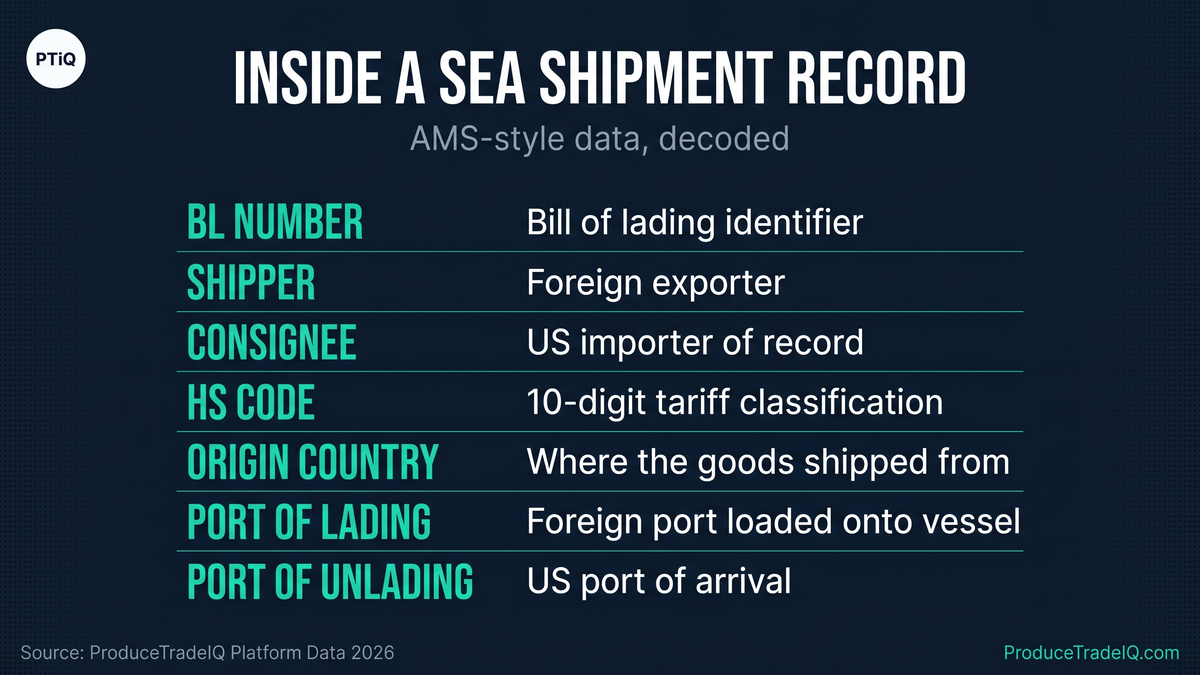
What's Actually in an AMS Record (Ecuadorian Pineapple, Decoded)
Here is one redacted shipment record from our platform's sea-mode feed, cleaned but otherwise unmodified:
| Field | Value |
|---|---|
| HS code | 0804300000 |
| HS description | Fruit, edible; pineapples, fresh or dried |
| Shipment date | 2026-02-24 |
| Origin country | ECUADOR |
| Country exp (ISO) | EC |
| Country imp (ISO) | US |
| Transport type | sea |
| Shipper name | [Exporter B] |
| Consignee name | [Importer A] |
| Products | CAJA DE PINAS |
| Port of lading | GUAYAQUIL - MARITIMO |
| Port of unlading | SAN DIEGO |
| Bill of lading | 028-XXXX601 |
| Quantity | 19,350 KILOGRAM GROSS |
| Invoice value | $11,250.00 USD |
Walking through it field by field:
- HS code 0804300000 — the 10-digit Harmonized Tariff Schedule classification for "Pineapples, fresh or dried." HS 0804.30 is pineapple specifically; the same chapter covers mangoes (HS 0804.50), guavas, and mangosteens. 6-digit HS is internationally standardized; the last 4 digits are US-specific tariff lines.
- Shipment date — the date the manifest was filed for vessel departure. Not the arrival date.
- Origin country / country_exp / country_imp — where the goods were grown and packed (ECUADOR), the ISO-2 export country code (EC), and ISO-2 import country code (US). On a clean AMS record, all three should align consistently.
- Transport type "sea" — confirms this is an AMS-equivalent record, not air or truck.
- Shipper / consignee — the two trade counterparties. Shipper is the foreign exporter (the Ecuadorian pineapple grower-exporter); consignee is the US importer of record. On AMS records, the consignee is the buyer who takes legal possession after customs clearance.
- Products — free-text product description filed by the shipper, often in the local language. "Caja de piñas" = "boxes of pineapples." Useful for variety and packaging hints when the HS code alone isn't specific enough.
- Port of lading "Guayaquil - Maritimo" — the foreign port where the cargo was loaded onto the vessel. Guayaquil is Ecuador's primary Pacific export port for fresh fruit.
- Port of unlading "San Diego" — the US port where the cargo was unloaded. San Diego serves the West Coast; Philadelphia, Wilmington DE, Port Everglades FL, and Long Beach are the other major fresh-produce sea-import ports.
- Bill of lading "028-XXXX601" — the steamship line's tracking identifier, redacted. Each BL number is the unique key for that specific cargo movement.
- Quantity / units — 19,350 kg gross weight. A 40-foot refrigerated container ("reefer") carries up to ~24,000 kg of fresh fruit, so this shipment used roughly 80% of one reefer.
- Invoice value — $11,250 USD as declared on the commercial invoice. At ~580 lbs per case of pineapples retail-packed, that's roughly $0.27 per pound at importer's cost — typical for off-season Ecuadorian Golden pineapple cleared at a US West Coast port.
A buyer reviewing this record can immediately see: who shipped, who bought, what variety/category, what port routing, what container utilization, what cargo value. That's the AMS-equivalent intelligence layer.
AMS vs AAMS vs ABI/ACE vs Pedimento — The Four Systems Behind Produce Trade Data
This is where most buyers' mental model breaks. There isn't one "import data" feed. There are four:
- AMS (Automated Manifest System) — US ocean only. 19 CFR 4.7. Carrier-filed 24 hours before vessel departs. The "AMS data" you see resold by ImportGenius, Panjiva, Datamyne. Covers Ecuadorian pineapple, Peruvian asparagus, Chilean grape, Vietnamese mango, and every other ocean-imported fruit and vegetable.
- AAMS (Air Automated Manifest System) — US air only. Separate filing, used for premium air-freight produce (some berries, off-season asparagus, specialty herbs).
- ABI (Automated Broker Interface) / ACE (Automated Commercial Environment) — the customs entry-summary side. Filed by the US licensed customs broker when the goods arrive and clear US customs. Covers all modes (sea, air, truck, rail). ACE is the modernized unified system; ABI is the legacy interface broker software still uses to talk to ACE. This is what tracks the formal duty-paying entry.
- Pedimento — the Mexican equivalent of ACE on the south side of the US-Mexico border. Pedimento (Spanish for "petition" or "declaration") is the Mexican customs declaration filed by Mexican customs brokers when goods clear out of Mexico, before the truck physically crosses. Every truck of Mexican avocados, tomatoes, cucumbers, mangoes, limes, peppers, and berries crossing into the US has a matching Pedimento on file with Mexican customs.
For US produce buyers, the data that covers most of what you actually buy is Pedimento. A Mexican-imported avocado, tomato, or cucumber has Pedimento data (south-side) and ACE entry data (north-side), but no AMS — because it never touched a vessel. Only sea-freight produce has AMS. Only air-freight produce has AAMS.
This is why "AMS data" is shorthand the trade-data industry uses but the term oversimplifies. AMS gives you ocean trade. For the full picture of US fresh-produce imports, you need AMS for sea + AAMS for air + Pedimento for Mexican land + ACE for the US-side entry summary on all of it. No single feed covers everything.
How ProduceTradeIQ Data is Sourced
We're transparent about the actual data composition. Across our platform's shipment-level records:
| Mode | CBP-equivalent system | Records | Share | Coverage window |
|---|---|---|---|---|
| Land — truck (Mexican imports) | Pedimento (south) ↔ ACE (north) | 128,977 | 62.5% | rolling 60 days |
| Sea (ocean imports, all origins) | AMS-equivalent | 73,676 | 35.7% | 11+ months back |
| Air (premium air freight) | AAMS-equivalent | 3,843 | 1.9% | 11+ months back |
Plus 241,939 commodity-month aggregates from the Census Bureau USA Trade Online (official trade statistics, not shipment-level — used for multi-year trend lines).
A few points worth surfacing:
- Most US-Mexico produce trade by volume is land-truck, which is why Pedimento dominates our shipment record count — see our cucumber importers post for what Pedimento data looks like in practice with a real January-February 2026 window.
- The AMS-equivalent sea slice (73,676 records over ~11 months) covers Ecuadorian, Peruvian, Chilean, Brazilian, Vietnamese, Indian, and Colombian fresh-produce imports.
- The Pedimento, AMS-equivalent, and AAMS-equivalent feeds are vendor-sourced — we don't directly file FOIA requests with CBP for raw AMS releases. Our vendors (including billofladingdata.com for the Mexican Pedimento side) aggregate and normalize CBP and Mexican customs data, and we license those feeds with produce-specific filtering and broker-placeholder cleanup applied on top.
What This Data Can Tell You
Once you understand which system covers which trade lane, the data is genuinely useful for sourcing decisions:
- Identify a competitor's supplier base. Search any US importer and see every Mexican exporter or foreign sea-exporter shipping to them. The AMS-equivalent + Pedimento combination is the foundation of competitive intelligence for produce procurement.
- Find new growers. Browse foreign exporters in your target origin and see which US importers they currently supply — and which they don't.
- Track variety shifts by season. Mexican Ataulfo dominates winter (the variety pattern visible in our January-February 2026 data); summer flips to Mexican Tommy Atkins, then Kent and Keitt, with Brazilian and Ecuadorian varieties filling shoulder months. Same buyer, different supplier mix by quarter.
- Monitor port-of-entry shifts. A buyer moving volume between Pharr and Nogales is signaling a supplier change or a rate-shopping move.
- Triangulate negotiation positions. Combined with FOB pricing data, shipment records let buyers cross-check what a supplier is shipping at what volume against the published FOB SC price. If your incumbent supplier's volume is dropping but published prices are firm, your negotiation leverage is changing.
The intelligence layer is the same one large importers have used for years — just made available to buyers who don't have an in-house data team.
Limitations: What's Missing and What's Redacted
Honest disclosure of what we don't cover:
- Vessel name and container number. Our vendor feed redacts these. We focus on buyer-supplier relationships and route-level intelligence, not vessel tracking. Different tool, different job — if you need to know which specific MSC reefer is sailing right now, ImportGenius and the carrier portals show that. We don't.
- FOIA confidentiality requests. Under 19 CFR 103.31(d), shippers can petition CBP to redact specific shipments from public AMS releases. Some BL numbers are missing on the public side for that reason — typically high-value or competitively-sensitive shipments. The 80.3% BL-fill rate on our sea data reflects this gap.
- Lag time. Typical 2-4 weeks between shipment date and data availability. Real-time shipment tracking is not what AMS-derived feeds do.
- Coverage windows. Pedimento is a rolling 60-day window. Sea/air goes 11+ months back. Census aggregates cover multi-year history. None of it is real-time.
- Pedimento vs ACE alignment. Same physical truck, two different filings, two different data sources. They don't perfectly join row-by-row. The Mexican-side Pedimento is more complete for produce buyer-supplier intelligence; the US-side ACE is more authoritative for duty-paid entry value.
How to Access This Data
Three paths:
- DIY via CBP FOIA — file a Freedom of Information Act request directly with CBP for raw AMS data. Free, but typical turnaround is 60-90 days. Returned data is unindexed CSV — you'll need your own ETL pipeline to make it queryable.
- Generalist trade-data subscriptions — ImportGenius, Panjiva (S&P Global), Datamyne, Volza, and others. Indexed, searchable AMS-derived data across all commodities, not produce-specific. Strong on sea ocean trade, weak on Mexican land-truck Pedimento.
- Produce-specific platforms — ProduceTradeIQ. Built for fresh-produce buyers, distributors, and trading companies. AMS-equivalent + Pedimento + AAMS-equivalent + USDA FOB SC pricing + USDA Market News tone — all unified. Broker placeholders and aggregator entities are filtered out so the rankings reflect actual buyers and suppliers, not customs paperwork artifacts.
Getting Started
CBP AMS is a precise term — ocean only, 19 CFR 4.7, vessel manifest. The trade-data industry uses "AMS data" colloquially to mean any indexed shipment-level import data, but for US fresh-produce buyers most of what you actually need is Pedimento + AMS-equivalent + ACE — three different systems unified into one queryable feed.
Start your free trial on ProduceTradeIQ to search shipment records by company, commodity, origin, port, or HS code. Cross-reference with importer profiles, shipment records, and USDA FOB prices — all in one platform. No credit card required.
Data sources: AMS-equivalent ocean and air shipment records from licensed CBP-derived vendor feeds. Pedimento land-truck records via billofladingdata.com vendor feed. Aggregate trade statistics from US Census Bureau USA Trade Online. Field-fill rates and the redacted Ecuadorian pineapple sample record were pulled directly from the ProduceTradeIQ platform database. AMS scope (ocean only, 19 CFR 4.7) is per US Customs and Border Protection regulation.
See this data live on ProduceTradeIQ
Search any company, product, or trade route. 7-day free trial.
Start Free Trial