May 4, 2026 · 7 min read
Top Cucumber Importers from Mexico in 2026
US fresh cucumber imports run through Mexico (year-round) and Canada (summer greenhouse). Top US buyers, shipment volumes, and how to track CBP data.
The United States imports more fresh cucumbers than it produces. According to USDA Economic Research Service data, imports captured nearly 90% of the US domestic cucumber market by 2020, up from 35% in the early 1990s — one of the largest origin shifts in the entire fresh produce category over the past three decades. Mexico is the dominant origin, supplying roughly three-quarters of every cucumber crossing the border by volume, with Canadian greenhouses filling the summer window.
Through the first two months of 2026, US Customs (CBP) shipment records show 7,812 estimated truckloads of cucumbers cleared at the Mexican border — roughly 3,900 truckloads per month, distributed across 177 US importers, 173 Mexican exporters, and four Mexican border states. The variety mix runs from standard field slicing cucumbers and pickling stock through Persian, English (greenhouse-grown), and mini varieties. For US buyers, distributors, and trading companies, knowing who imports which varieties at which border port is foundational sourcing intelligence.
Who Are the Top US Cucumber Importers?
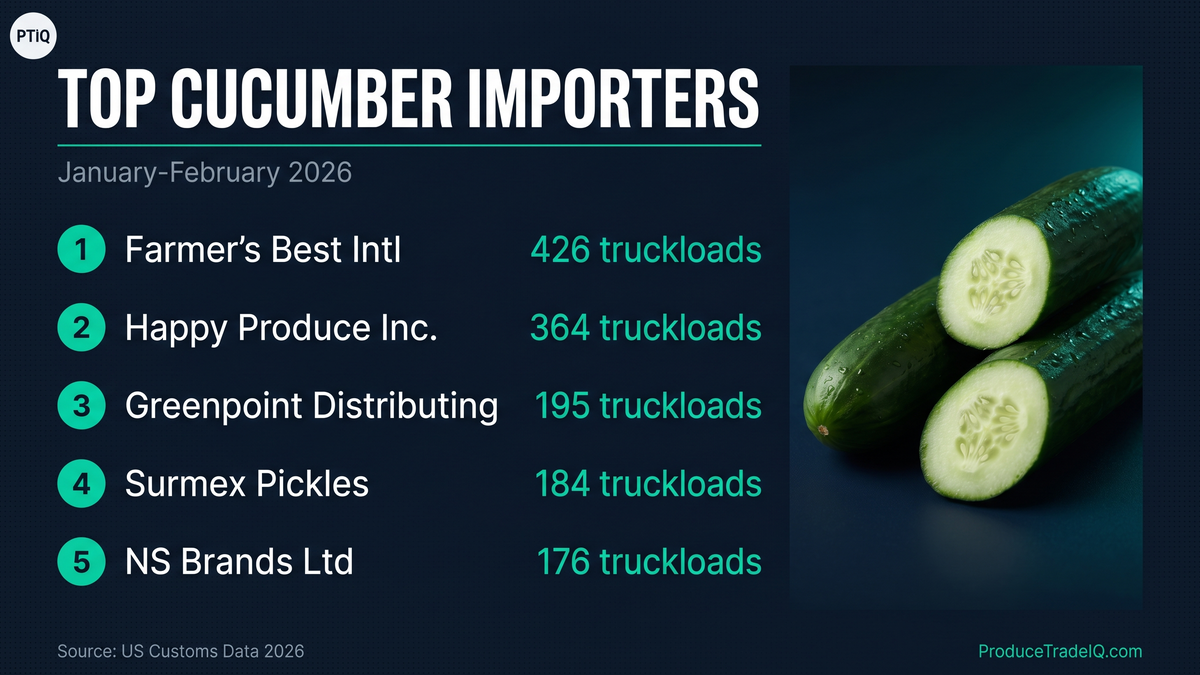
Based on CBP shipment data from January-February 2026 (the latest verifiable cucumber records on ProduceTradeIQ), here are the top seven US cucumber importers ranked by physical truckload volume:
| Rank | US Importer | Truckloads | Customs Decl. | Mexican Suppliers |
|---|---|---|---|---|
| 1 | Farmer's Best International LLC | 426 | 17 | 3 |
| 2 | Happy Produce Inc. | 364 | 18 | 1 |
| 3 | Greenpoint Distributing LLC | 195 | 23 | 4 |
| 4 | Surmex Pickles LLC | 184 | 3 | 1 |
| 5 | NS Brands Ltd | 176 | 69 | 5 |
| 6 | Hayun Trading FZ-LLC | 166 | 12 | 1 |
| 7 | Grower Alliance LLC | 146 | 61 | 4 |
Methodology: Truckloads are estimated from line-item kilogram weights (qty1 in CBP records) divided by 22,000 kg per refrigerated trailer. Customs declarations is the count of distinct entry filings; a single declaration typically bundles multiple physical truckloads. Broker placeholders and aggregator entities flagged in the ProduceTradeIQ audit are excluded.
Farmer's Best International LLC leads the category with 426 truckloads — roughly 7 truckloads per day during the Mexican winter peak. The company operates out of Nogales, Arizona and runs an integrated grower-importer model, sourcing from a small concentrated supplier base (3 Mexican exporters across 17 declarations). Happy Produce Inc. ranks second at 364 truckloads (consolidated across two CBP name variants), also Sonora-routed.
Greenpoint Distributing LLC at #3 shows a notably more diversified supplier mix — 195 truckloads across 4 Mexican exporters and 23 declarations, suggesting a broader sourcing strategy than the top two. Surmex Pickles LLC at #4 is a category outlier: 184 truckloads from a single Mexican supplier across just 3 declarations, indicating high-volume contracted pickling stock rather than spot-market slicing cucumbers.
NS Brands Ltd (NatureSweet) ranks #5 by volume but #1 by declaration count (69 declarations across 5 suppliers), reflecting its high-frequency, small-load model typical of branded retail produce programs. Grower Alliance LLC shows a similar pattern at #7. Outside the top seven, well-known names like Mastronardi Produce Limited (Sunset), Wholesum Family Farms (organic), Divine Flavor LLC, and Comarca Fresh also appear in the top 15 — a mix of branded greenhouse, organic, and specialty importers.
On the Canadian side, US import flow is dominated by greenhouse cucumber operations from Leamington, Ontario and Delta, British Columbia. Brands like Mastronardi (Sunset), Pure Flavor, NatureFresh, Mucci Farms, and Red Sun Farms run year-round greenhouse production but their US-bound flow peaks in the summer months when Mexican volume tapers.
Why Sonora Dominates US Cucumber Imports
CBP records show Mexican cucumber traffic to the US is heavily concentrated through Sonora — and by extension, the Nogales, Arizona port of entry:
| Mexican Border State | Truckloads | US Port of Entry | Share |
|---|---|---|---|
| Sonora | 5,064 | Nogales, AZ | 64.8% |
| Tamaulipas | 2,549 | Pharr / McAllen / Hidalgo, TX | 32.6% |
| Baja California Norte | 197 | Otay Mesa / San Ysidro, CA | 2.5% |
| Nuevo León | 1 | Colombia Solidarity / Laredo, TX | <0.1% |
Roughly two out of every three cucumber truckloads from Mexico cross at Nogales. The reason is geographic and operational: Sonora and the bordering Sinaloa growing regions produce the bulk of Mexico's slicing-cucumber and Persian-cucumber output, and the Mariposa cargo facility in Nogales is purpose-built for produce throughput, with lanes dedicated to refrigerated trailers, USDA inspection capacity, and direct connections to I-19 north toward Tucson and onward distribution.
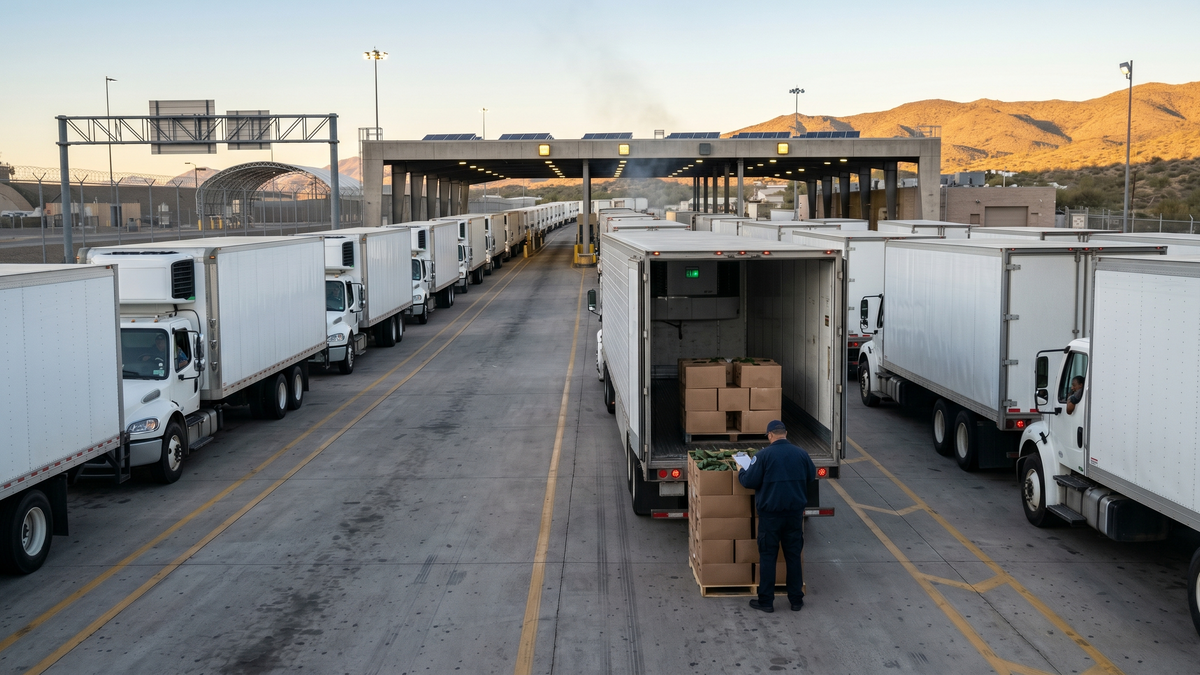
The Pharr-Reynosa International Bridge handles the Tamaulipas flow at 32.6% of cucumber imports, primarily greenhouse cucumbers and some pickling stock from operations in northeastern Mexico. Otay Mesa's small share (2.5%) is consistent with the cucumber category — unlike tomato or strawberry, Baja California is not a major cucumber growing region.
For more detail on the trade-offs between border crossings, see our guides on the Nogales, Arizona produce import corridor and the McAllen-Pharr Texas port.
Cucumber Varieties: What Crosses the Border
CBP product descriptions in cucumber declarations reveal a clear varietal split:
- Slicing cucumbers (standard field): The base of the category. Filed as PEPINO or PEPINOS in product descriptions. Standard 24-count or 36-count cases bound for retail produce departments and foodservice. The largest single-line item in the dataset — roughly 2,919 truckloads in January--February 2026 alone.
- Pickling cucumbers (gherkins): Filed as PEPINO PICKLE or PICKLING CUCUMBER, often in bins rather than retail cases. About 562 truckloads. Almost entirely contracted to processors, not retail buyers — which is why a single importer like Surmex Pickles can hold a top-five rank with just three customs declarations.
- Persian cucumbers (mini snacking): Filed as PEPINO PERSA. The fastest-growing segment of the category, popular for retail snacking packs (5-count bags, organic and conventional). Roughly 90 truckloads filed under explicit Persian descriptions; actual volume is higher because some Persian shipments file under generic PEPINO.
- English / European greenhouse cucumbers: Filed as PEPINO EUROPEO. Long, seedless, individually shrink-wrapped. Roughly 76 truckloads in the dataset. Greenhouse-grown, increasingly competitive with Canadian summer supply.
- Mini and organic specialties: PEPINO MINI ORGANICO and similar descriptors appear in roughly 100 truckloads. Specialty retail mix.
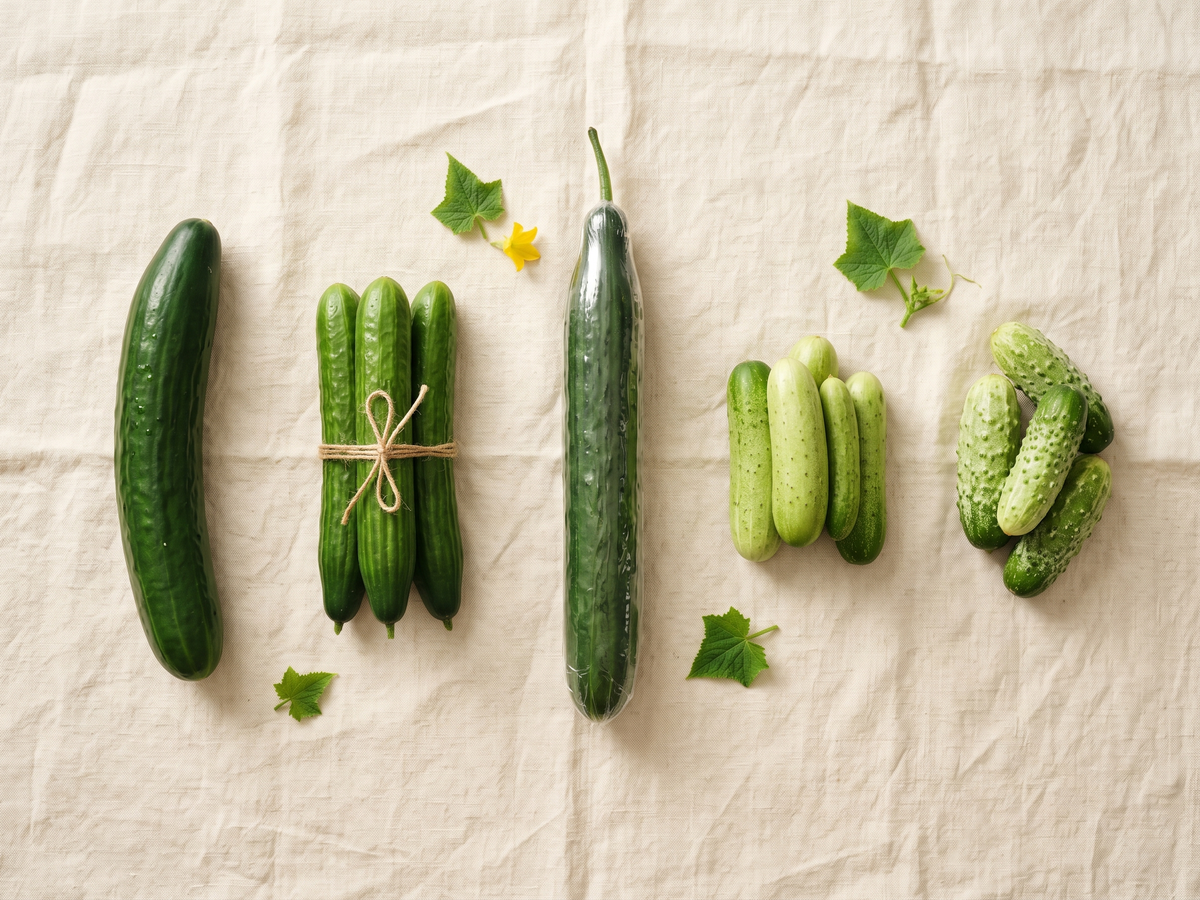
The variety mix has shifted meaningfully over the last decade. Persian and English cucumbers were a small share of US import flow in 2015; in 2026 they are a category retailers actively allocate retail real estate for.
Cucumber Import Seasonality
Unlike tomatoes or strawberries, fresh cucumber imports run nearly year-round, but the origin mix shifts by season:
- November--May (Mexican winter and spring peak): Sinaloa and Sonora field cucumber and protected-agriculture operations push the highest volume into the US market. Canadian greenhouses are at their lowest output for the year. CBP data for January--February 2026 captures the heart of this window: 3,961 estimated truckloads in January, 3,850 in February — a near-steady-state flow of refrigerated trailers across the Sonora-Arizona border.
- June--October (Canadian summer greenhouse peak): Ontario and BC greenhouse cucumber output rises, supplying the eastern and northern US through the Detroit-Windsor and Buffalo-Niagara corridors. Mexican volume tapers as Sinaloa transitions out of cucumber rotation. Domestic US production (Georgia, North Carolina, Florida, Michigan) also fills part of this gap for retail.
- Transition months (May, October): Pricing volatility tends to be highest as supply hands off between origins. Track weekly cucumber FOB prices on the ProduceTradeIQ USDA dashboard to see how the handoff plays out across major US terminal markets.
This year-round import flow is the structural reason cucumber imports have captured nearly 90% of the US domestic cucumber market: domestic field production simply cannot match the consistency that Mexican and Canadian greenhouse operations now deliver.
Top Mexican Cucumber Exporters
The supplier side of the cucumber market is more concentrated than the buyer side. The top five Mexican cucumber exporters during January--February 2026 moved nearly 2,500 truckloads — about 32% of total cucumber import volume:
| Rank | Mexican Exporter | Truckloads | Decl. | US Buyers |
|---|---|---|---|---|
| 1 | Ceuta Produce S de RL de CV | 841 | 17 | 1 |
| 2 | Productos Agrícolas de Nueva Italia SA | 495 | 8 | 1 |
| 3 | Agrícola La Tuxcana SA de CV | 429 | 26 | 1 |
| 4 | MJ International / Fresh Farms (Sinaloa) | 391 | 9 | — |
| 5 | Happy Greenhouse S de RL de CV | 364 | 18 | 2 |
The single-buyer pattern at the top of this list is striking: each of the top three Mexican exporters supplies essentially one US importer at scale. This is the integrated grower-shipper-buyer model in practice — Mexican production tied to a specific US distribution arm, often through a long-running contractual or ownership relationship.
For US buyers looking to source cucumbers, this concentration is both a constraint and an opportunity. Top exporters are typically locked into existing US relationships, but the long tail (the 168 other Mexican exporters in the dataset) includes smaller growers and packers actively looking for buyers.
How to Find Cucumber Suppliers
Practical approach using trade data:
- Identify top importers in your target market. Use Competitor Intel to search for cucumber importers. Filter by truckload volume, by city or state, or by border port.
- Look at supplier relationships. Each importer's profile shows their top Mexican suppliers — which growers and packers are reliable enough to maintain ongoing trade with major US buyers.
- Track shipment frequency. A supplier shipping consistently every week beats one with sporadic activity. Check cucumber shipment records to see individual crossings, dates, weights, and customs ports.
- Match origin to season. Mexican volume runs strongest November--May. Canadian greenhouse fills June--October. Sourcing patterns should follow this rhythm.
- Match variety to channel. Slicing cucumbers for foodservice and retail; Persian and English for retail snacking and high-end produce; pickling stock for processors only. Each channel has distinct preferred suppliers.
- See who imports what: Search any company name and view their cucumber shipment history, volume trends, and supplier list.
- Find new suppliers: Browse Mexican cucumber exporters and see which US importers they currently supply.
- Monitor competitors: Track when a competitor adds a new supplier or shifts volume between Sonora and Tamaulipas.
- Analyze border patterns: See which ports — Nogales, Pharr, McAllen, Otay Mesa — handle the most cucumber traffic.
- Check FOB prices: USDA daily prices for cucumbers at major US terminal markets, with historical trends and regional comparisons.
Track Cucumber Import Data in Real Time
ProduceTradeIQ gives you access to the same customs data that large cucumber importers use to monitor competitors. For cucumbers specifically, you can:
All data comes from official US government sources — CBP import records and USDA Market News — updated weekly.
Getting Started
The cucumber import market is large, year-round, and highly concentrated through the Nogales corridor. Mexican supply dominates by volume; Canadian greenhouse operations fill the summer window; US domestic field production is now a minority of total availability.
Whether you're an established importer benchmarking your position or a buyer looking for new Mexican or Canadian suppliers, having access to shipment-level CBP data gives you a meaningful advantage on pricing, sourcing, and competitive intelligence.
For the live version of this roster — current importers and shipment volumes from CBP records, plus USDA FOB prices — see our Mexican cucumber importers page.
Start your free trial on ProduceTradeIQ to search cucumber importers, view shipment records, and track FOB USDA prices — all in one platform. No credit card required.
Data sources: USDA Economic Research Service ("Fresh cucumber imports capture nearly 90 percent of U.S. market," June 2021); CBP import records via ProduceTradeIQ; USDA Market News. Top importer and exporter rankings drawn from January-February 2026 CBP shipment records (HS code 0707, fresh cucumbers and gherkins). Broker placeholders and aggregator entities flagged in the ProduceTradeIQ audit are excluded.
See this data live on ProduceTradeIQ
Search any company, product, or trade route. 7-day free trial.
Start Free Trial