May 11, 2026 · 7 min read
Top US Importers of Mexican Onions (2026 Data)
92% of Mexican onion volume crosses through one US port. Tamaulipas grows 80% of it. Top buyers, suppliers, and why winter onion comes from one state.
Mexican onion is the most geographically concentrated produce commodity in our May 2026 data: 80% of trucks come from a single state (Tamaulipas), and 91.9% of all volume crosses through a single US port (Pharr-McAllen, TX). For comparison, mango runs 64.5% Pharr; Sinaloa-vegetables run 62.5% Nogales; cucumber runs 64.8% Sonora. None of those approach onion's single-corridor concentration.
That concentration isn't accidental. Mexican commercial onion production is regional, seasonal, and east-Mexico-centric — and the result is a buyer-supplier ecosystem narrower than any other Mexican produce category we've documented. This guide covers who imports it, who exports it, why white onion (cebolla blanca) dominates the variety mix, and why winter onion comes from Tamaulipas while Chihuahua sits out the January-February window entirely.
Who Are the Top US Mexican-Onion Importers?
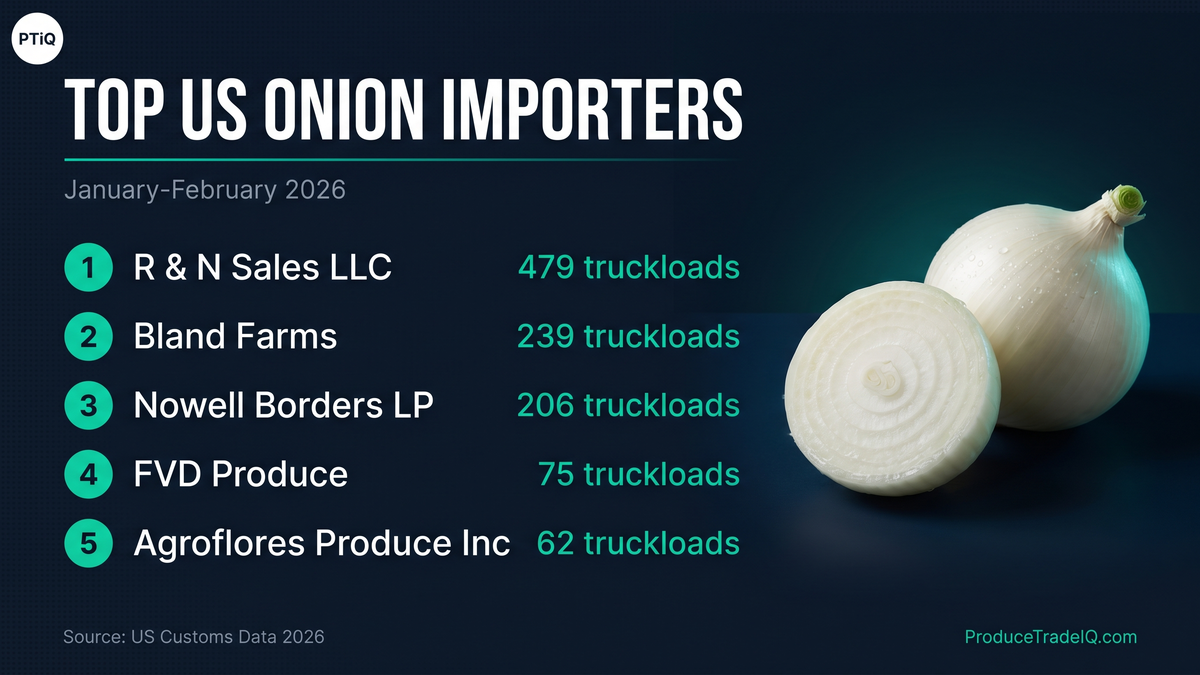
Ranked by truckload volume from CBP shipment data, January-February 2026 (after consolidating LLC name variants and excluding broker placeholders):
| Rank | US Importer | Trucks | Decl. | Value (USD) | Suppliers |
|---|---|---|---|---|---|
| 1 | R & N Sales LLC | 479 | 8 | $891K | 2 |
| 2 | Bland Farms | 239 | 12 | $662K | 1 |
| 3 | Nowell Borders LP | 206 | 12 | $453K | 2 |
| 4 | FVD Produce | 75 | 10 | $153K | 3 |
| 5 | Agroflores Produce Inc | 62 | 7 | $357K | 2 |
| 6 | Colossal Produce Corporation | 47 | 8 | $138K | 1 |
| 7 | Crown Jewels Produce Company LLC | 43 | 9 | $48K | 1 |
| 8 | Primo Trading Services LLC | 39 | 7 | $42K | 1 |
| 9 | Senor Cebolla USA LLC | 33 | 7 | $364K | 2 |
| 10 | Anavale Produce Corp. | 28 | 9 | $135K | 3 |
Methodology: Truckload count = sum of CBP line-item kilograms (qty1 where uom1 = KGM) divided by 22,000 kg per refrigerated trailer. HS prefix 0703.10 (onions, shallots) further filtered to product descriptions containing "CEBOLLA" but not "CEBOLLIN" — isolates onion bulb trade from green-onion / scallion / shallot trade. Broker placeholders excluded.
R & N Sales LLC dominates the rankings — 479 truckloads from a concentrated 2-supplier base in Tamaulipas. Bland Farms at #2 is the famous Vidalia sweet onion brand from Georgia: their Mexican import program supplements the Vidalia harvest window (April-August in Georgia) with year-round Mexican-supplied volume, allowing them to maintain a continuous distribution program rather than a Vidalia-season-only one. Nowell Borders LP at #3 is a Texas-based onion specialist — combined across two CBP name-variant filings (Nowell Borders L.P. + Nowell Borders LP) for accuracy.
A charming detail in the data: Senor Cebolla USA LLC at #9 — literally "Mr. Onion USA" — is exactly what the name suggests, an onion-specialist importer working directly off the Tamaulipas supply.
The long tail beyond the top ten includes 72 additional US importers actively bringing in Mexican onion during this window. For buyers looking to enter the category, the long tail is where open supplier relationships live; the top six importers are typically already locked into specific Tamaulipas growers.
Why Tamaulipas? Mexico's Winter Onion Geography
Mexican commercial onion production runs on a regional + seasonal calendar that's invisible if you assume "Mexican onion" is one thing. It isn't. The Jan-Feb 2026 origin state breakdown:
| Mexican State | Exporters | Trucks | Value (USD) | Share of trucks |
|---|---|---|---|---|
| Tamaulipas | 21 | 1,307 | $3.4M | ~80% |
| Baja California | 12 | 122 | $633K | 7% |
| Nuevo León | 8 | 55 | $584K | 3% |
| Guanajuato | 3 | 36 | $434K | 2% |
| Morelos | 4 | 34 | $506K | 2% |
| Puebla | 6 | 24 | $255K | 1% |
| Sinaloa | 4 | 14 | $220K | <1% |
| Veracruz | 2 | 9 | $76K | <1% |
| Chihuahua | 3 | 8 | $122K | <0.5% |
| Sonora | 1 | 2 | $143K | <0.1% |
Tamaulipas is the winter onion state. Production is concentrated in the Río Bravo valley near Reynosa and Matamoros — a low-elevation, mild-winter agricultural region that grows onion through the US winter window. Outputs harvest through January-March and ship directly across the Pharr-Reynosa International Bridge to US distribution.
Chihuahua, by contrast, is the summer onion state. Production peaks April-June. In our January-February window, Chihuahua contributed just 8 trucks — essentially nothing. A buyer expecting Chihuahua-sourced onion in Q1 would be looking at the wrong calendar.
This regional split also explains why onion is conspicuously absent from our Sinaloa export guide. Sinaloa's export profile is tomato, pepper, cucumber, squash, eggplant — vegetables that thrive in its Pacific-coast subtropical climate. Onion isn't a Sinaloa crop at commercial scale; the four Sinaloa exporters in our data moved 14 trucks combined, less than any single one of the top Tamaulipas growers. Same border, different commodities, different states. Compare with cucumber's Sinaloa-dominant pattern: cucumber is 90+% Sinaloa-origin going through Nogales; onion is 80%+ Tamaulipas-origin going through Pharr. Two completely separate Mexican produce ecosystems running parallel.
The smaller central-Mexico contributions — Guanajuato, Morelos, Puebla, Nuevo León — supply mostly specialty and seasonal onion for niche US channels, not the mainstream foodservice/retail volume that drives the top rankings.
Cebolla Blanca: Why White Onion Dominates
Onion isn't one variety. The CBP product descriptions in our window break down roughly:
| Description (translated) | Trucks | Notes |
|---|---|---|
| Bagged onion (sacks/burlap) | 267 | "ARPILLAS CON CEBOLLA" — 50-lb mesh sacks, mainstream foodservice/retail format |
| Fresh bagged onion | 246 | "SACOS ARPILLAS CON CEBOLLA FRESCA" |
| Bins of onion | 196 | bulk format for processors / repackers |
| Generic "CEBOLLA" | 135 | no color specified |
| White onion (cebolla blanca) | 134 | explicit white-onion designation |
| Yellow onion (cebolla amarilla) | 35 | smaller share |
White onion (cebolla blanca) is the dominant variety story when color is explicit, by roughly 4:1 over yellow onion. The demand pattern explains it: white onions are the staple variety in Mexican-American foodservice, salsa production, and ethnic-retail channels where Mexican-grown product carries provenance preference. Tacos, salsa cruda, pico de gallo, chiles toreados, ceviches, escabeches — all built on white onion as the cooked or raw allium of choice. Yellow onion dominates Anglo-American retail (caramelized, soup-base, mirepoix), but that demand is largely served by US domestic supply (Idaho, Washington, New Mexico, California).
Mexican onion exports to the US are therefore structurally weighted toward white onion in a way that domestic US supply isn't. Buyers serving Hispanic-foodservice or ethnic-retail channels source heavily from Tamaulipas; buyers serving general retail and foodservice rotate their onion sourcing across US domestic, Tamaulipas, and (in summer) Chihuahua.
This same demand-channel logic explains the Mexican import patterns in our pepper importers post — chiles (jalapeño, serrano, poblano, Anaheim) and white onion travel through the same buyer ecosystem because they're paired ingredients in the same cuisine.
Pharr: The Onion Corridor
| Mexican Border State | Trucks | Value (USD) | Share | US Port of Entry |
|---|---|---|---|---|
| Tamaulipas | 1,506 | $5.87M | 91.9% | Pharr / McAllen / Hidalgo, TX |
| Baja California Norte | 118 | $612K | 7.2% | Otay Mesa / San Ysidro, CA |
| Chihuahua | 8 | $122K | 0.5% | Columbus, NM / El Paso, TX |
| Sonora | 7 | $202K | 0.4% | Nogales, AZ |
Pharr-McAllen handles 91.9% of Mexican onion volume — the most concentrated single-port commodity in our May arc data. For comparison: mango runs 64.5% Pharr; Sinaloa-origin vegetables run 62.5% Nogales; cucumber runs 64.8% Sonora. None of those even approach onion's single-corridor concentration.
The geographic logic is direct. Mexican-onion production is east-Mexico-centric (Tamaulipas plus Baja California plus the central states). From any of these origins, the natural distribution route runs through the Pharr-Reynosa International Bridge into South Texas, then onward via I-2 / I-69 to Houston, Dallas, the Southeast, and the East Coast. Almost no onion volume moves through Nogales because Mexican production simply isn't on the Pacific corridor. Same logic in inverse explains why Sinaloa-origin cucumber, tomato, and pepper run through Nogales: they're produced in northwestern Mexico and travel up Mexican Federal Highway 15 to the Sonora-Arizona border.
Each onion truck filing has a corresponding Mexican Pedimento (south-side customs declaration) and a US ACE entry summary (north-side). All onion trade is 100% Pedimento-anchored data — no AMS involvement, since onion never crosses by sea. See our CBP AMS data explainer for how the four customs systems behind US produce trade work.
Top Mexican Onion Exporters
Truckload-ranked supplier side from mx_shipments, January-February 2026:
| Rank | Mexican Exporter | State | Trucks | Decl. | Value (USD) | Buyers |
|---|---|---|---|---|---|---|
| 1 | Promesa de Tamaulipas SA de CV | Tamaulipas | 479 | 8 | $891K | 2 |
| 2 | Rancho Aguamarina SPR de RL | Tamaulipas | 246 | 15 | $682K | 2 |
| 3 | Agroproductos Capricho S de RL de CV | Tamaulipas | 132 | 5 | $291K | 2 |
| 4 | Rancho Thomas SPR de RL | Tamaulipas | 82 | 16 | $90K | 2 |
| 5 | Fronteras Export de Mexico SA de CV | Tamaulipas | 64 | 5 | $141K | 2 |
| 6 | Produce Flores JL SPR de RL | Tamaulipas | 63 | 7 | $366K | 1 |
| 7 | La Lajilla SPR de RL | Tamaulipas | 56 | 5 | $109K | 1 |
| 8 | Fernando de Jesús Rodríguez Mendoza | Tamaulipas | 53 | 12 | $165K | 9 |
| 9 | Alejandra Estrada Jasso | Tamaulipas | 50 | 30 | $410K | 6 |
| 10 | María de los Ángeles Ruiz Huerta | Baja California | 47 | 8 | $138K | 1 |
Nine of the top ten exporters are Tamaulipas-based — the geographic concentration is extreme. The single-buyer pattern in the buyer-count column (most exporters supplying just 1-2 US importers) reflects the same integrated grower-shipper-buyer model observed across Mexican produce: a Tamaulipas operation tied contractually or by ownership to a specific US distribution arm.
A notable feature of the Mexican onion supplier base: *three of the top ten exporters are persona física (individual person names) rather than corporate entities — Fernando de Jesús Rodríguez Mendoza, Alejandra Estrada Jasso, and María de los Ángeles Ruiz Huerta. Persona física* is a Mexican legal classification for an individual conducting commercial activity directly under their own name (rather than via an SA de CV or SPR de RL corporate structure). This pattern appears more frequently in onion than in our other commodity data — reflecting the smaller-grower, family-operation segment of the Mexican onion industry. These exporters tend to supply more US buyers each (Fernando de Jesús Rodríguez Mendoza supplies 9 different US importers in our window; Alejandra Estrada Jasso supplies 6), which is the inverse of the corporate exporter pattern.
How to Track Mexican Onion Suppliers
ProduceTradeIQ surfaces every shipment-level CBP record from Mexican onion across truck mode (the dominant channel) and sea/air for non-Mexican origins. For Mexican onion specifically:
- Filter by Tamaulipas origin. Use Competitor Intel and search Mexican shipper names or addresses containing "TAMAULIPAS" to surface every active winter-onion exporter.
- Track shipment frequency by week. A consistent weekly Tamaulipas shipper beats one with sporadic activity. Shipment records show every individual crossing date and weight.
- Cross-reference exporter-importer pairs. Each importer profile shows their Tamaulipas supplier base. R & N Sales LLC ↔ Promesa de Tamaulipas, Bland Farms ↔ specific suppliers, etc. — visible in the data.
- Compare against USDA FOB onion prices. Pharr FOB SC is the relevant pricing reference for Mexican onion; the platform's /prices feed surfaces same-day quotes. See our FOB vs CIF explainer for how shipping-point pricing works in the produce industry.
- Watch for seasonal shifts. As April-May approaches, Chihuahua suppliers will begin appearing in the data. By June, the Mexican onion source mix flips entirely from Tamaulipas (winter) to Chihuahua (summer).
Getting Started
Mexican onion is the narrowest single-corridor produce category in our May 2026 data: one state grows it, one US port handles it, and one buyer ecosystem (Hispanic foodservice + ethnic retail + sweet-onion brand off-season programs) absorbs the volume. For buyers in those channels, the ten US importers and ten Tamaulipas exporters above represent essentially the entire commercial market.
Start your free trial on ProduceTradeIQ to search Mexican onion shipments by importer, exporter, or border port; see who's buying from Tamaulipas; and track USDA FOB onion prices at Pharr in real time. No credit card required.
Data sources: CBP-derived shipment records via the ProduceTradeIQ platform (mx_shipments table, HS prefix 0703.10, filtered to onion-only via product_desc containing "CEBOLLA" and excluding "CEBOLLIN" scallions). Window: January 1 – February 28, 2026. Truckload counts derived from line-item kilograms divided by 22,000 kg standard refrigerated trailer payload. USD values are sums of CBP-reported invoice values. Origin state attribution derived from shipper_address field. Broker placeholders and aggregator entities flagged in the ProduceTradeIQ audit are excluded.
See this data live on ProduceTradeIQ
Search any company, product, or trade route. 7-day free trial.
Start Free Trial