May 13, 2026 · 6 min read
Persian Lime vs Tahiti Lime: Same Fruit, Two Names
4,252 truckloads, zero labeled "Tahiti." Mexico calls it Limón persa. Same Citrus latifolia. Plus how Key lime is the actually-different cultivar.
Mexican exporters shipped 4,252 truckloads of Citrus latifolia to the US in January-February 2026. Zero were labeled "Tahiti." The world's largest lime exporter calls it Limón persa — full stop. The "Persian vs Tahiti" debate is a US-side artifact, not a real distinction. Same cultivar, different commercial names depending on which country grew it commercially first.
The genuinely different lime — the one buyers should be choosing between — is Key lime (Citrus aurantiifolia), which is botanically distinct from Persian/Tahiti and used differently in foodservice, retail, baking, and bar programs. This guide settles the Persian/Tahiti naming question, breaks down the actually-distinct Persian/Tahiti vs Key lime comparison, and shows where the cultivar split shows up in Mexican customs data.
Persian = Tahiti: The Naming Story
Citrus latifolia is the same cultivar wherever it's grown. The naming divergence happened at the commercial level, not the botanical level:
| Market | Name used in trade and retail |
|---|---|
| United States (English) | Persian lime or Tahiti lime (used interchangeably) |
| Mexico (Spanish) | Limón persa (universal — never Tahití) |
| Brazil (Portuguese) | Limão Tahiti |
| Latin / Botanical | Citrus latifolia (also Citrus × latifolia) |
Why the divergence? California citrus growers branded the cultivar "Persian lime" in the early 1900s when they brought it to commercial scale, leaning on the cultivar's then-believed origin in Persia. Brazilian commercial growers, who built the Western Hemisphere's other major lime industry through a parallel import lineage, anchored on "Tahiti" as the cultivar's commercial origin. Both names took root regionally and persist today. The fruit is identical; the names are colonial-era branding artifacts.
For US buyers, the practical implication is that "Tahiti lime" on a US menu, retail label, or product spec sheet is the same product as "Persian lime" on the next page. There's no taste difference, no size difference, no seasonal difference, no sourcing difference. It is one cultivar with two English brand names that happen to coexist in the US market.
The supplier-side data confirms this cleanly. In 4,252 January-February 2026 Mexican lime truckloads — covering 188 distinct exporters and 960 customs declarations — the word "Tahiti" appears zero times in product descriptions. The Mexican lime industry, which supplies essentially all US lime imports, ships under one name: Limón persa. Wonderful Citrus Ventures, the #1 US importer of Mexican Persian lime, brands the same fruit "Persian" in US retail. It crosses the border as persa and reaches US shelves as Persian — the cultivar is consistent end-to-end.
So What's Actually Different? Meet Key Lime
Key lime (Citrus aurantiifolia) is the genuinely distinct lime cultivar — botanically separate from Persian/Tahiti and visually different in ways buyers will notice immediately.
It originated in Southeast Asia, was carried to the Mediterranean by Arab traders during the 8th-10th centuries, then to the Caribbean by Spanish colonists in the 16th century. It was brought to the Florida Keys centuries later, where US commerce gave it the regional name "Key lime." Mexico calls the same fruit limón mexicano or limón criollo — and it remains the lime most Latin-American households cook with daily, despite being the smaller share of the US import trade.
Key visual differences a buyer can spot at a glance:
- Smaller — 30-40g per fruit vs Persian/Tahiti's 80-120g (roughly half the size)
- Rounder — circular cross-section vs Persian/Tahiti's oval-elongated shape
- Yellower at maturity — turns yellow-orange when fully ripe, where Persian/Tahiti stays dark green even at full maturity
- Seedier — 10-15 visible seeds per fruit vs Persian/Tahiti's effectively-seedless flesh
- Thinner-rinded — less protective rind, shorter shelf life
- More aromatic — the floral, complex aroma that defines Key lime pie, classic margarita recipes, and ceviche across Latin America
These aren't subtle differences. Set a Persian lime next to a Key lime on a cutting board and any retail clerk, bartender, or chef will identify them instantly. Persian/Tahiti is the bigger, smoother, seedless lime; Key is the smaller, rounder, seedy, more aromatic lime.
Spec Comparison: Persian/Tahiti vs Key Lime
| Attribute | Persian/Tahiti (*Citrus latifolia*) | Key Lime (*Citrus aurantiifolia*) |
|---|---|---|
| Size | 80-120g, 5-7cm diameter | 30-40g, 3-5cm diameter |
| Shape | Oval-elongated | Round |
| Color at maturity | Dark green (most US retail) → yellow if fully ripe | Yellow-orange when fully ripe |
| Seeds | Effectively seedless | 10-15 visible seeds |
| Rind | Thicker, smoother | Thinner, more textured |
| Juice content per fruit | High | Lower per fruit (smaller size) |
| Acidity | High (~6-8% citric) | Higher (~7-9%) |
| Aroma profile | Crisp, less complex | Floral, complex, "tropical" |
| Storage life refrigerated | 2-3 weeks | 1-2 weeks |
| Per-fruit cost | Lower | Higher |
Per-pound juice yield is the metric that drives commercial decisions. Persian/Tahiti gives more juice per fruit and per case, which means lower juice cost per gallon for foodservice and processing. Key lime gives a more complex aroma but at higher per-fruit cost and lower juice yield. The choice between them comes down to whether the buyer's channel prizes cost-efficiency or aromatic profile.
When to Source Each One
Match the cultivar to the channel:
- Foodservice retail — Persian/Tahiti by default. Bigger fruit, more juice per case, lower seed count, longer shelf life. The "limes for the bar" or "limes for the produce display" sourcing decision is almost always Persian/Tahiti unless the operator specifically requests Key.
- Bar / cocktail programs — split by program type. Classic Margarita programs built with Mexican (Key) lime — the cultivar most early recipes assumed when the drink originated in northern Mexico — versus modern high-volume bar programs built with Persian/Tahiti for cost and consistency. Tiki and Polynesian programs anchor on Key for the aromatic profile (Mai Tai, Daiquiri Floridita); modern volume bars rotate to Persian/Tahiti for inventory predictability.
- Juice production — both, depending on price and aroma target. Industrial lime juice (bottled, branded foodservice) is mostly Persian/Tahiti for cost efficiency. Premium "fresh-squeezed" lime juice programs and craft cocktail batchers often specify Key for the aroma.
- Ethnic-grocery / Mexican-American channels — Limón mexicano (Key lime) is what households cook with. It's the lime in agua de limón, ceviche, fresh salsa, mole verde, and corn-on-the-cob garnish. The provenance preference matches the cuisine. Hispanic foodservice and tienda-channel buyers often source both, with Key dominating fresh-prep applications and Persian for general cocktail and garnish use.
- Baking / pies — Key lime dominant. Key lime pie is its own product category with its own consumer expectations; substituting Persian breaks the recipe (different aroma + acidity profile). Consumers can taste the difference, and "made with Persian lime" loses the menu-claim premium.
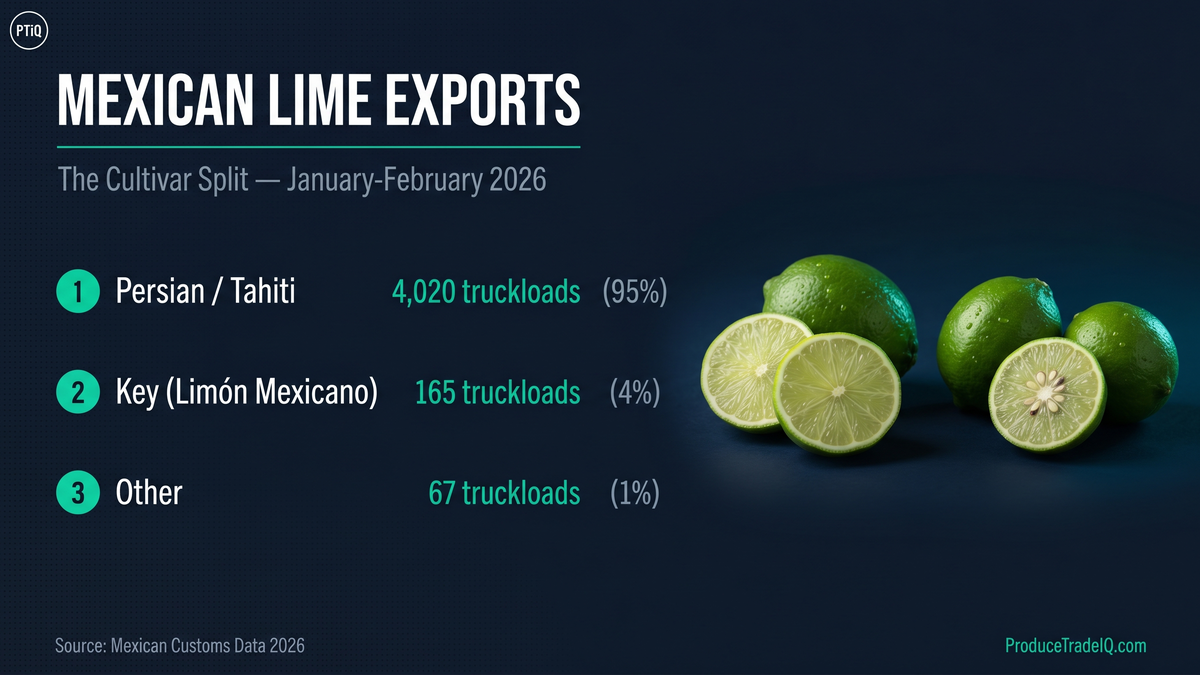
US Supply Reality: 95% Persian, 4.4% Key
Mexican Pedimento (the south-side customs declaration system) splits the cultivars at the HS subcode level — which makes lime the only commodity in our May arc data with hardcoded cultivar separation in the trade-data layer:
| Mexican Pedimento HS subcode | Trucks | Share | Cultivar |
|---|---|---|---|
| 805500302 | 4,020 | 94.5% | Limón persa (Persian/Tahiti, C. latifolia) |
| 805500301 | 165 | 3.9% | Limón mexicano (Key, C. aurantiifolia) |
| 805500399 | 67 | 1.6% | Other / non-classified |
| Total | 4,252 | 100% | $126.3M January-February 2026 value |
Cleaner cultivar separation than any other Mexican produce category we've documented. Buyers and customs filers who specify by HS subcode get exactly what they're paying for — distinct from cucumber, tomato, mango, watermelon, and onion, where variety distinctions show up only in product descriptions and not in the HS code itself.
For volume-leader detail (top US importers, top Mexican exporters, border corridor breakdown for Persian lime specifically), see our top US Persian lime importers post — the new spec/cultivar guide complements rather than overlaps. The volume-rankings post covers "who's buying"; this post covers "what is a lime, technically."
A geographic note: lime is not a Sinaloa commodity. Veracruz, Tabasco, Michoacán, Tamaulipas, Oaxaca, and Colima dominate Mexican lime production. The non-Sinaloa pattern matches onion's geography (also non-Sinaloa) — same border, different commodities, different states. Approximately 90% of Mexican lime crosses Tamaulipas → Pharr-McAllen, with the remainder routing through Baja California and Sonora.
The platform's lime data is ~100% Pedimento-anchored, with negligible sea-trade volume in our Jan-Feb 2026 window. See our CBP AMS data explainer for how the four customs systems behind US produce trade work — Mexican lime is the cleanest case for "the data is in Pedimento, not AMS."
How to Specify and Source Limes
A practical buyer's checklist:
- HS subcode clarity. US HTS classifies the cultivars separately: 0805.50.20 (Persian/Tahiti) vs 0805.50.30 (Key lime). Mexican Pedimento mirrors this with 805500302 (persa) vs 805500301 (mexicano). Specifying the right subcode at the broker matters because it affects duty rates, FDA Prior Notice categorization, and downstream USDA grading. See our CBP AMS / Pedimento explainer for the customs filing context.
- What to ask suppliers. Specify cultivar by name ("limón persa" vs "limón mexicano/criollo"), pack size (40-lb bulk, 12×3-lb mesh, 17×2-lb retail), seed count tolerance for Persian (effectively zero — anything above 1-2 seeds per fruit is a quality issue), USDA grade (No. 1, Combination, etc.), and color at receipt (most Persian retail spec is dark green; Key spec varies retailer to retailer).
- FOB SC pricing context. Pharr FOB SC carries the daily Persian lime quote on USDA Market News — the relevant pricing benchmark for Mexican-import volume. See our FOB vs CIF explainer for how shipping-point pricing works in the produce industry. Key lime FOB quotes are smaller-volume and reported less consistently, so price discovery for Key is more direct-supplier-quoted than market-published.
- Branded program awareness. "PERSIAN LIME" as a printed pack designation typically means Persian-only with no Key mixed in; verify this before high-volume contract commitments. Some Mexican shippers run dual-cultivar programs, so the cultivar declaration on the customs documentation should match the pack label.
Getting Started
Persian and Tahiti are the same fruit. Key is the actually-different one. Match the cultivar to the channel, specify by HS subcode for customs clarity, and use the existing volume-rankings post for the "who buys what" view of the market.
Start your free trial on ProduceTradeIQ to search Mexican lime shipments by importer, exporter, cultivar (via HS subcode), or border port; track USDA FOB lime prices at Pharr FOB SC; and cross-reference the top US Persian lime importers post for volume-leader detail. No credit card required.
Data sources: CBP-derived shipment records via the ProduceTradeIQ platform (mx_shipments table, HS 0805.50 with subcode-level breakdown). Window: January 1 – February 28, 2026. Truckload counts derived from line-item kilograms divided by 22,000 kg standard refrigerated trailer payload. Cultivar attribution derived from Mexican Pedimento HS subcode (805500302 vs 805500301) cross-referenced against product_desc keyword matching. Botanical classification reflects industry-standard Citrus latifolia (Persian/Tahiti) and Citrus aurantiifolia (Key) cultivar separation.
See this data live on ProduceTradeIQ
Search any company, product, or trade route. 7-day free trial.
Start Free Trial