May 12, 2026 · 7 min read
Top US Watermelon Importers from Mexico (2026 Data)
Watermelon imports split 50/50 between Nogales and Pharr — the most balanced Mexican produce corridor. Top US buyers, suppliers, and origin states.
If onion is the most concentrated Mexican produce import in our May arc data — 80% from one state, 92% through one US port — watermelon is the structural opposite. Six Mexican states grow it at material commercial scale, the buyer base sources from across the country, and US-bound volume splits roughly 50/50 between Nogales and Pharr-McAllen. There's no single dominant corridor.
Through January-February 2026, US Customs (CBP) shipment records show 3,345 estimated truckloads of watermelon cleared at the Mexican border — distributed across 69 US importers, 73 Mexican exporters, and the most diversified Mexican origin-state mix in our data. Every record was Mexican: zero sea-trade watermelon shipments in our window. The multi-country watermelon calendar (Guatemala, Honduras, Costa Rica, Dominican Republic) starts later in the spring; Jan-Feb is the all-Mexico window.
Who Are the Top US Watermelon Importers?
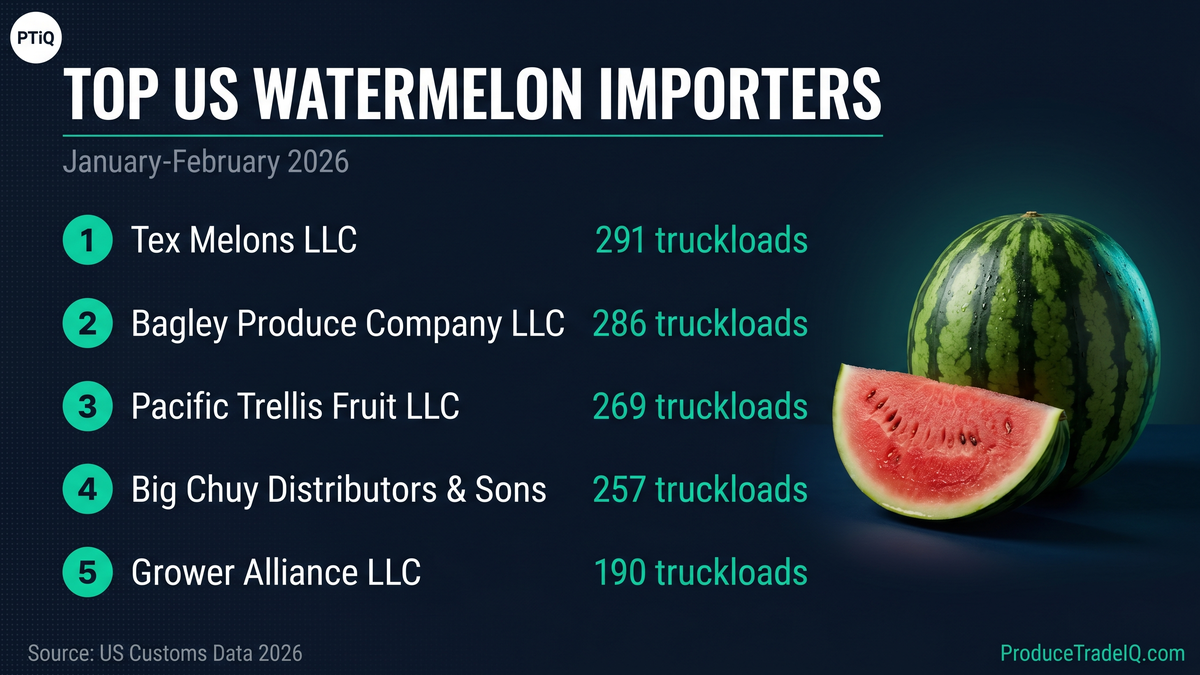
Ranked by truckload volume from CBP shipment data (after consolidating LLC name variants and excluding broker placeholders):
| Rank | US Importer | Trucks | Decl. | Value (USD) | Suppliers |
|---|---|---|---|---|---|
| 1 | Tex Melons LLC | 291 | 5 | $635K | 2 |
| 2 | Bagley Produce Company LLC† | 286 | 32 | $1,100K | 16 |
| 3 | Pacific Trellis Fruit LLC† | 269 | 19 | $1,461K | 4 |
| 4 | Big Chuy Distributors & Sons Inc | 257 | 21 | $603K | 4 |
| 5 | Grower Alliance LLC | 190 | 26 | $569K | 6 |
| 6 | Sandia Depot Inc | 166 | 8 | $427K | 2 |
| 7 | Nowell Borders LP | 159 | 15 | $392K | 4 |
| 8 | Grower's Select Produce Inc. | 155 | 31 | $1,337K | 7 |
| 9 | BJ Brothers Produce | 100 | 5 | $742K | 1 |
| 10 | Shipley Sales LLC | 93 | 8 | $27K | 1 |
†Combined across LLC casing variants. Methodology: Truckload count = sum of CBP line-item kilograms (qty1 where uom1 = KGM) divided by 22,000 kg per refrigerated trailer. HS prefix 0807.11 (watermelons, fresh). Broker placeholders excluded.
Tex Melons LLC leads the category with 291 truckloads from a tight 2-supplier base — a Texas-named watermelon specialist. Bagley Produce Company LLC at #2 (consolidated across two LLC variants) runs the most diversified Mexican supplier base in the top ten (16 distinct shippers across 32 declarations). Pacific Trellis Fruit LLC at #3 — also consolidated — and Big Chuy Distributors & Sons at #4 round out the lead pack. ("Chuy" is a Mexican nickname for Jesús; this is a family-named Mexican-American distributor.) Grower Alliance LLC at #5 is a known Mexican-vegetable buyer who also appears at #7 in our cucumber importers post — a cross-commodity sourcing operation that covers vegetables and melons together.
A charming detail in the data: Sandia Depot Inc at #6 — literally "Watermelon Depot" in Spanish — is the second onomastic specialist the May arc has surfaced, after "Senor Cebolla USA LLC" ("Mr. Onion") in our onion importers post. Specialty Spanish-named importers focused on a single Mexican-origin commodity are a recognizable feature of the Hispanic-foodservice and ethnic-retail buyer ecosystem.
Nowell Borders LP at #7 is also a cross-commodity pattern: same buyer appears at #3 in our onion data, with 206 truckloads of Tamaulipas onion in the same window. Nowell Borders LP is a Texas-based importer running concurrent winter-onion and spring-watermelon programs out of Pharr — exactly the kind of multi-Mexican-origin specialist the long tail produces.
The buyer count beyond the top ten reaches 69 active US importers — a healthier long tail than onion (82 importers) given watermelon's smaller total volume. New buyers entering the watermelon category have meaningful supplier-relationship runway.
All Mexican, All Winter
Every US watermelon import in our January-February 2026 data was Mexican. Zero sea-trade records appeared in the zari dataset for HS 0807.11 in this window — no Guatemala, no Honduras, no Costa Rica, no Dominican Republic. The multi-country watermelon calendar kicks in later in the spring:
- Mexico — December through May (peak January-March): the dominant winter and spring origin. Production runs across Pacific-coast and east-Mexico states.
- Guatemala — March through May: Pacific-coast lowland production crosses by sea via the East Coast US ports (Philadelphia, Wilmington DE, Port Everglades FL).
- Honduras — April through June: similar geography to Guatemala, slightly later season.
- Costa Rica and Dominican Republic — summer counter-seasonal: smaller specialty volume filling US-domestic gaps.
- US domestic — late April onward: Florida starts late April, Georgia / Texas / South Carolina / North Carolina ramp through May-June, Mid-Atlantic and Northeast peak in July-August.
For Jan-Feb buyers, Mexico is the entire market. Buyers planning year-round watermelon programs need Mexican commitments locked in before October to secure capacity at the right shippers, then transition to Guatemala/Honduras/Costa Rica through spring, then to US domestic for summer-fall. The all-Mexican Jan-Feb window means that for retail and foodservice buyers anchored on the winter-spring shoulder, the Mexican supplier base is your supplier base — full stop.
Six Mexican States, One Crop
Watermelon is the most geographically distributed Mexican commodity in our May arc data. Six states each contribute >100 truckloads in the Jan-Feb window:
| Mexican State | Exporters | Trucks | Value (USD) | Per-truck $ |
|---|---|---|---|---|
| Jalisco | 20 | 768 | $3.59M | $4,675 |
| Tamaulipas | 9 | 765 | $1.87M | $2,444 |
| Colima | 7 | 543 | $4.02M | $7,403 |
| Sinaloa | 14 | 491 | $1.80M | $3,665 |
| Nayarit | 7 | 408 | $3.24M | $7,941 |
| Sonora | 9 | 388 | $2.18M | $5,619 |
| Quintana Roo | 1 | 138 | $2.10M | $15,217 |
| Guerrero | 2 | 97 | $443K | $4,567 |
| Baja California | 7 | 63 | $751K | $11,921 |
| Morelos | 3 | 49 | $316K | $6,449 |
Jalisco leads by trucks (768), Colima leads by value ($4.02M from 543 trucks — the highest per-truck value among major-volume states). This trucks-vs-value split is a signal worth reading carefully. Jalisco produces high-volume mainstream watermelon for retail and foodservice channels at moderate per-truck prices. Colima — a much smaller state geographically — concentrates on premium watermelon programs, including the Robinson Fresh / Starr Produce branded program visible in product descriptions ("SANDIA ROBINSON FRESH SUPER STARR" appears in 42 truckloads). The premium end of the Mexican watermelon trade routes through Colima even though the volume center is Jalisco.
Sinaloa contributes 491 truckloads — material but minority. This fits the broader Sinaloa portfolio profiled in our Sinaloa export guide, where watermelon is one of several smaller categories alongside Sinaloa's tomato/pepper/cucumber dominance. Tamaulipas (765 trucks) is the only east-Mexico state in the top six; the rest are Pacific-coast.
Quintana Roo at 138 trucks from a single exporter at $15,217 per truck is the value outlier — a niche premium program, possibly tied to specific retail labels.
Variety Mix: Seedless Dominates, Labeling Doesn't
The CBP product descriptions in our window show a generic-labeling problem: most shipments file as "SANDIA" without specifying variety. Among labeled records:
| Description (translated) | Trucks | Notes |
|---|---|---|
| SANDIA (generic) | 1,273 | no variety specified |
| SANDIA FRESCA (fresh) | 423 | |
| SANDIA SIN SEMILLA (seedless explicit) | 266 | + 23 SEEDLESS = 289 explicit seedless |
| SANDIA A GRANEL (bulk) | 182 | bins/loose, processor / repacker channel |
| SANDIA BOLA (round) | 59 | round-shaped variety designation |
| SANDIA ROBINSON FRESH SUPER STARR | 42 | branded program (Robinson Fresh + Starr Produce, Colima) |
| MINI / PERSONAL (small-format) | 35 | personal-size watermelon, growing premium segment |
Honest disclosure: explicit-seedless labeling captures 9% of trucks (289 of 3,345), but the watermelon industry has been widely known to be 85%+ seedless for over a decade. Seedless watermelon dominance isn't visible in our explicit-label data because shippers generally don't tag variety in product_desc when seedless is the default expectation. The takeaway: when you see "SANDIA" with no variety qualifier, it's almost certainly seedless. Treat the explicit-seedless rows as a floor, not a ceiling.
The mini / personal-size watermelon segment (35 trucks) is small but worth flagging as the growing premium category — single-serving watermelon for snack-pack retail, adult-shopper convenience programs, and food-as-medicine wellness positioning.
The Most Balanced Border Corridor
| Mexican Border State | Trucks | Value (USD) | Share | US Port of Entry |
|---|---|---|---|---|
| Sonora | 1,725 | $9.99M | 51.6% | Nogales, AZ |
| Tamaulipas | 1,554 | $6.18M | 46.4% | Pharr / McAllen / Hidalgo, TX |
| Baja California Norte | 66 | $761K | 2.0% | Otay Mesa / San Ysidro, CA |
| Chihuahua | 1 | $10K | 0.0% | Columbus, NM / El Paso, TX |
Watermelon runs a near-50/50 split between Nogales and Pharr — by far the most balanced port mix of any commodity in our May arc data. For comparison: onion 91.9% Pharr, mango 64.5% Pharr, cucumber 64.8% Sonora/Nogales, Sinaloa-vegetables 62.5% Sonora/Nogales. None of those approach watermelon's near-parity split.
The geographic logic is direct: watermelon's six-state production geography spans both sides of Mexico, so its border crossings split evenly between Pacific corridor and east corridor. Pacific-state production (Jalisco, Colima, Nayarit, Sinaloa, Sonora) routes north up Mexican Federal Highway 15 to the Mariposa cargo facility at Nogales. East-state production (Tamaulipas) routes through the Pharr-Reynosa International Bridge into South Texas. The two flows are roughly evenly weighted because the underlying production is roughly evenly distributed between the two sides of Mexico.
For US buyers, this matters for logistics planning. A watermelon importer building a national distribution program needs dual-corridor sourcing: relationships with Pacific-state shippers crossing Nogales (for west-coast and mountain-west distribution) and east-state shippers crossing Pharr (for Texas, Southeast, and East Coast distribution). The handful of buyers running pure single-corridor programs are limiting their geographic reach.
Top Mexican Watermelon Exporters
Truckload-ranked supplier side from mx_shipments, January-February 2026:
| Rank | Mexican Exporter | State | Trucks | Decl. | Value (USD) | Buyers |
|---|---|---|---|---|---|---|
| 1 | Claudia Elizabeth Mejía Chavero | Tamaulipas | 320 | 6 | $700K | 3 |
| 2 | Felipe de Jesús Michel Saucedo | Colima | 233 | 16 | $571K | 3 |
| 3 | Peinado/Bobadilla/Raúl José | Sinaloa | 176 | 8 | $259K | 1 |
| 4 | Myrna Guadalupe Pérez Martínez | Tamaulipas | 157 | 6 | $346K | 1 |
| 5 | Starr Produce SPR de RL | Colima | 138 | 9 | $2,100K | 3 |
| 6 | Grupo Agropecuario El Anticipo 2020 SPR de RL | Sonora | 136 | 9 | $160K | 1 |
| 7 | Comercio Exterior Kai-Zen S de RL de CV | Sonora | 111 | 12 | $1,567K | 4 |
| 8 | Los Madera de lo Arado SPR de RL | Jalisco | 109 | 11 | $742K | 4 |
| 9 | Exportadora Vica Fresh SA de CV | Nayarit | 108 | 16 | $1,285K | 4 |
| 10 | Rancho Agricola Las Cabras SPR de RL de CV | Sinaloa | 102 | 7 | $756K | 1 |
The persona física pattern is even stronger than in onion. Three of the top four watermelon exporters are individual person names (Mexican legal classification for an individual conducting commercial activity directly under their own name, rather than via an SA de CV or SPR de RL corporate structure):
- Claudia Elizabeth Mejía Chavero at #1 — 320 truckloads from Tamaulipas, supplying 3 US importers
- Felipe de Jesús Michel Saucedo at #2 — 233 truckloads from Colima
- Myrna Guadalupe Pérez Martínez at #4 — 157 truckloads from Tamaulipas
Plus Peinado/Bobadilla/Raúl José at #3 — a less common but legal persona física variant where multiple individuals (typically family members) conduct trade under a slash-separated joint name, recorded by Mexican customs as a single declarant.
This pattern reflects the smaller-grower, family-operation segment of the Mexican watermelon industry. Watermelon — like onion before it — is more individually-held at the production level than the corporate-shipper-dominated tomato/pepper/cucumber categories. For buyers, the practical implication is that working with a top-tier watermelon exporter often means working directly with a family business owner-operator rather than an industrial corporate sales team. The contracting and relationship dynamics are different — and worth understanding before starting a sourcing program.
Each watermelon truck filing has a corresponding Mexican Pedimento (south-side customs declaration) and a US ACE entry summary (north-side). 100% Pedimento-anchored data — no AMS involvement, since watermelon never crosses by sea in our window. See our CBP AMS data explainer for how the four customs systems behind US produce trade work.
How to Track Watermelon Suppliers
ProduceTradeIQ surfaces every shipment-level CBP record from Mexican watermelon, plus sea-trade records once Guatemala/Honduras/Costa Rica enter the spring shoulder. For watermelon specifically:
- Filter by origin state. Use Competitor Intel to surface Jalisco, Colima, Tamaulipas, Sinaloa, Nayarit, Sonora exporters separately — each state has distinct supplier characteristics.
- Track the corridor split by buyer. Pacific-corridor buyers (Nogales-based) and east-corridor buyers (Pharr-based) are largely separate ecosystems. The platform shows which buyer uses which crossing.
- Watch branded programs. Robinson Fresh + Starr Produce (Colima), and other branded watermelon programs appear with consistent product descriptions — useful for following high-margin specialty segments.
- Cross-reference USDA FOB watermelon prices. Both Nogales FOB SC and Pharr FOB SC carry weekly watermelon quotes. See our FOB vs CIF explainer for how shipping-point pricing works in the produce industry.
- Watch for the March origin-mix shift. As Guatemalan and Honduran sea-trade watermelon enters in March-April, the data composition changes from 100% Mexican to a multi-country mix. Buyers who track that transition gain pricing leverage.
Getting Started
Watermelon is the structurally distributed Mexican import in our May arc data — six states, two corridors, a buyer base spanning specialty to mainstream. For a US buyer building a year-round watermelon program, the Jan-Feb supplier base in Mexico is your foundation, and the data above shows exactly which Mexican operations move what volume to which US distributors.
Start your free trial on ProduceTradeIQ to search Mexican watermelon shipments by importer, exporter, origin state, or border port; see who's buying from Jalisco vs Colima vs Sonora; and track USDA FOB watermelon prices at Nogales and McAllen FOB SC in real time. No credit card required.
Data sources: CBP-derived shipment records via the ProduceTradeIQ platform (mx_shipments table, HS prefix 0807.11). Window: January 1 – February 28, 2026. Truckload counts derived from line-item kilograms divided by 22,000 kg standard refrigerated trailer payload. USD values are sums of CBP-reported invoice values. Origin state attribution derived from shipper_address field. Broker placeholders and aggregator entities flagged in the ProduceTradeIQ audit are excluded. Sea-trade Guatemala / Honduras / Costa Rica / Dominican Republic shipments produced zero records in the window — those origins enter the multi-country watermelon trade later in the spring.
See this data live on ProduceTradeIQ
Search any company, product, or trade route. 7-day free trial.
Start Free Trial