May 6, 2026 · 7 min read
FOB vs CIF Explained: A Produce Buyer's Pricing Guide
FOB and CIF are the two pricing conventions every produce buyer needs to know — but the produce industry uses FOB differently. Here's how it actually works.
The same word "FOB" can mean two different things in produce procurement, depending on whether you're looking at an import contract drafted by a freight forwarder or a USDA Market News report quoted by a US distributor. International trade lawyers and freight specialists use FOB to mean the Incoterms 2020 definition — a sea-freight rule with a precise risk-transfer point at the named port of loading. The US fresh-produce industry uses FOB SC to mean a domestic shipping-point quote at a US packing house, border crossing, or repack hub. Both are legitimate. Both appear on documents you'll see. Confusing them costs money.
This guide explains how FOB and CIF are defined in international trade, how the produce industry uses an idiosyncratic version of FOB that doesn't match the textbook, and what the four most-recent USDA Market News rows from May 1, 2026 look like once you can read them without confusion.
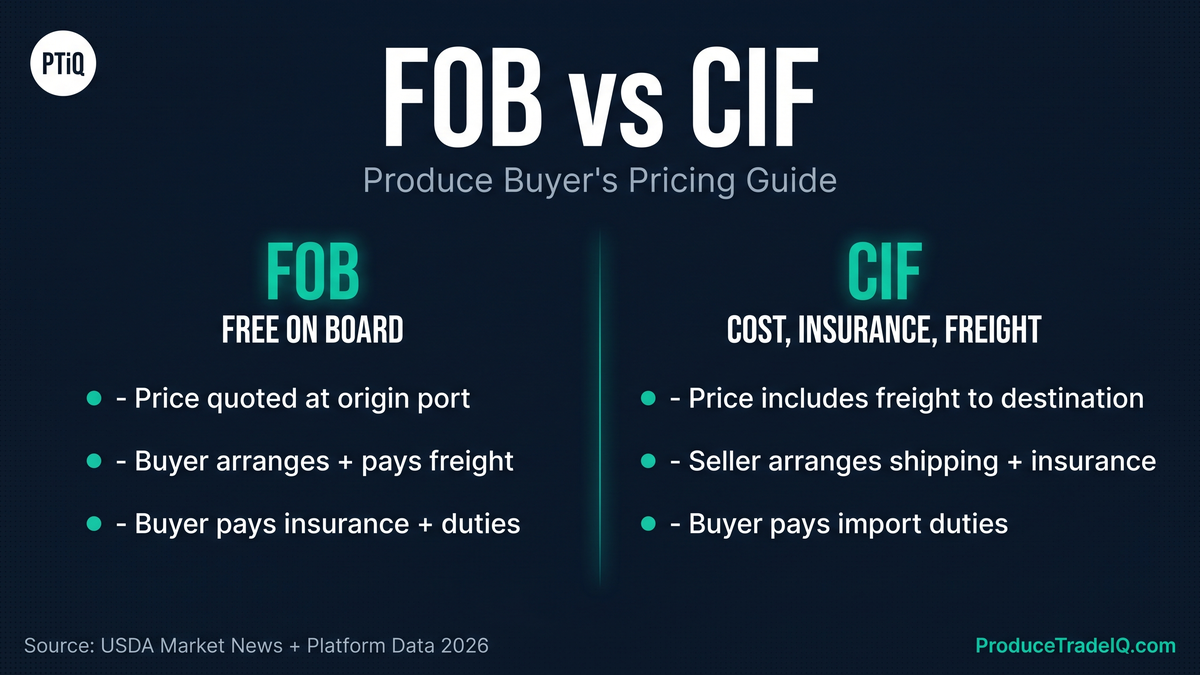
What Is FOB (Free on Board)?
FOB ("Free on Board") is one of the eleven Incoterms 2020 rules — the standard set of international commercial terms maintained by the International Chamber of Commerce. Under Incoterms 2020 FOB:
- The seller is responsible for delivering goods on board the vessel at the named port of loading (e.g., "FOB Valparaíso" or "FOB Manzanillo")
- Risk transfers when the goods are placed on board the vessel at the named port of loading
- The seller covers all costs up to that point: factory or packing-house preparation, USDA grading or origin inspection, transport to the port, port-handling charges, and loading
- The buyer covers ocean freight, marine insurance, destination port charges, customs clearance, and onward delivery
FOB is a sea-freight or inland-waterway rule. It cannot be used for road, rail, or air freight under Incoterms 2020 — Incoterms reserves FCA (Free Carrier) for those modes. (You'll still see "FOB" used loosely in everyday speech to mean any origin-priced sale, but in a legal trade contract the term has the narrow definition above.)
What Is CIF (Cost, Insurance, Freight)?
CIF is also an Incoterms 2020 sea-freight rule. Under CIF:
- The seller delivers goods on board the vessel at the named port of loading (same as FOB)
- The seller pre-pays ocean freight to the named destination port
- The seller arranges minimum-coverage marine insurance covering the buyer's risk during the sea passage
- Risk transfers when the goods are placed on board the vessel at the named port of loading — the same risk-transfer point as FOB
- The buyer covers destination port charges, import customs clearance, and onward delivery
The seller's CIF price quote includes the goods plus freight plus insurance, but the buyer is still the at-risk party once the goods are on board. The seller is essentially handling the freight + insurance leg as a service inside the price — useful for buyers who don't want to negotiate ocean freight or marine insurance separately.
FOB vs CIF: The Side-by-Side
| Element | FOB (Incoterms 2020) | CIF (Incoterms 2020) |
|---|---|---|
| Quoted price includes | Goods + origin handling + loading | Goods + freight + insurance to destination port |
| Who arranges ocean freight | Buyer | Seller |
| Who pays ocean freight | Buyer | Seller (passed through in the quoted price) |
| Who arranges marine insurance | Buyer | Seller (minimum coverage) |
| When risk transfers | When goods are on board the vessel at the named port of loading | When goods are on board the vessel at the named port of loading (same as FOB) |
| Who pays import duties | Buyer | Buyer |
| Mode of transport | Sea / inland waterway only | Sea / inland waterway only |
| Total cost predictability for the buyer | Lower (freight rates + insurance fluctuate) | Higher (one all-in price) |
The single non-obvious detail in this table — and the one that trips up most procurement readers — is that risk transfers at the same point under both terms: when the goods are placed on board the vessel at the named port of loading. The seller pays the freight + insurance under CIF as a service, but the legal risk-bearing party from the moment the goods are on the vessel is the buyer in both cases.
Why "FOB SC" Isn't Textbook FOB (the produce-industry version)
This is where US produce buyers get into trouble.
USDA Agricultural Marketing Service publishes daily wholesale price reports — the "FOB" prices that the entire fresh produce industry references. Those quotes are labeled with market locations like "Nogales FOB SC", "McAllen FOB SC", "Fresno (FR) FOB SC", and "Orlando (Imports) FOB SC". The "SC" stands for Shipping Contract (also known as Shipping Point) — and this is not Incoterms 2020 FOB.
Produce-industry FOB SC means:
- Price is quoted at a US shipping point — a packing house, border-crossing distribution hub, or repack facility on US soil
- The price reflects the goods after USDA grading, sorting, repackaging, and palletizing — ready to be loaded onto the buyer's truck
- Risk transfers when the goods are loaded onto the buyer's truck at the shipping point
- The buyer arranges and pays road freight from the shipping point onward
Compare that to textbook Incoterms 2020 FOB, where the named port is a foreign port of loading and the risk-transfer is on board a vessel. Under FOB SC, the named location is a US-side packing house or border, and the risk-transfer is onto a truck. Different mode of transport, different geography, different point of risk transfer. Same three letters.
The May 1, 2026 USDA report on Chilean Red Globe grapes is the cleanest example of how this plays out. The shipment data shows three geographic anchors:
- Chile — the country of origin where the grapes were grown and packed
- Philadelphia — the US port of entry where the grapes physically arrived by sea (the district field reads "CHILE IMPORTS - PORT OF ENTRY PHILADELPHIA AREA")
- Orlando — the US shipping point where the FOB SC price is quoted, after the grapes have been cleared, repacked, and sold on to receivers
A textbook Incoterms 2020 FOB price for the same grapes would be quoted at "FOB Valparaíso" or "FOB San Antonio" — a Chilean port, before the Pacific transit. A textbook CIF price would also be quoted at those Chilean ports, but with freight + insurance to the US destination port (Philadelphia) included. The USDA-quoted FOB SC price is none of these — it is the price at Orlando, after a multi-week sea voyage, after US customs and USDA inspection, after repackaging at a Florida distribution facility. It's a domestic US wholesale price, expressed in the produce industry's idiosyncratic FOB convention.
For US produce buyers, this matters because:
- USDA Market News FOB SC prices are the right benchmark for domestic US wholesale negotiations with importers, distributors, and re-shippers
- They are the wrong benchmark for negotiating directly with a Chilean exporter — those quotes would be in Incoterms 2020 FOB or CIF terms, with very different cost structure (no US-side handling, no repack, no domestic freight)
- A buyer mistaking FOB SC for textbook FOB risks under-quoting their freight burden by the entire ocean-freight + customs + repack leg
Real-World FOB Examples from May 1, 2026
Four rows pulled from the same USDA Market News reporting day. Each is a USDA-reported FOB SC price — the produce-industry version, not Incoterms.
Roma Plum Tomatoes — Mexican import via Nogales
- Variety: Roma
- Region: Southwest (Nogales FOB SC, Arizona)
- Package: 25 lb cartons loose, medium size
- Low-high: $28.95 – $34.95 per carton
- Mostly: $32.95 – $34.95
- Market tone: Lower
The "Mostly" range — sometimes called the "mostly low" / "mostly high" — is USDA Market News terminology for the price band where most of the day's reported sales clustered, distinct from the wider "low-high" overall range. If the low was $28.95 but the mostly was $32.95, it means a few transactions printed at the low end but the bulk of the day's volume traded around $33-$34. For procurement, the mostly band is usually the more useful number — it's where you should expect to negotiate, not the full low-high spread.
The "Market tone" field is USDA's directional read on whether the market is moving up, down, or steady relative to the prior report. "Lower" means downward pressure since the last reporting day — useful for catching trend reversals before they show up in an averaged number.
Chilean Red Globe Grapes — sea import via Orlando
- Variety: Red Globe
- Region: Florida (Orlando (Imports) FOB SC)
- District: CHILE IMPORTS - PORT OF ENTRY PHILADELPHIA AREA
- Package: 18 lb containers bagged, jumbo size
- Low-high: $30.00 – $36.00 per container
- Mostly: $32.00 – $34.00
- Market tone: Lower; supply tone Light
This is the three-anchor example from §5 in concrete numbers. The price is FOB SC at Orlando, but the goods physically arrived at Philadelphia. The "Light" supply tone (supply_tone field) flags that Chilean season is winding down — a procurement signal that prices may firm up before the next origin (US domestic California grapes, starting late summer) takes over.
California Strawberries — domestic CA
- Region: California (Fresno (FR) FOB SC)
- Package: flats 8 × 1-lb containers with lids, medium size
- Low-high: $18.00 – $22.00 per flat
- Mostly: $20.00 (flat — both mostly low and mostly high were $20.00)
- Market tone: About Steady
Domestic example for contrast. The "About Steady" tone is the most common signal in the data — markets at equilibrium, no pressure either direction. When mostly-low equals mostly-high (both $20.00 here), it means the day's reported sales clustered tightly around a single price point — a signal of price discovery rather than a wide negotiating range.
Mexican Ataulfo Mangoes — McAllen FOB SC
- Variety: Ataulfo
- Region: Southwest (Mcallen FOB SC, Texas)
- Package: cartons 1 layer, 20s (count per case)
- Low-high: $5.00 – $6.00 per carton
- Market tone: Ataulfo lower, Tommy Atkins slightly higher
Smaller package size, smaller dollar figures — but the Ataulfo / Tommy Atkins split in the market_tone field shows USDA's variety-level granularity. This is the same Ataulfo mango category profiled in our mango importers post, priced at the Mexican-import shipping point on the same USDA reporting day.
When FOB vs CIF Matters for Buyers
For most US produce buyers buying through a US distributor or importer, FOB SC is the only price you will ever see — your supplier negotiates Incoterms FOB or CIF with the foreign exporter, handles the sea freight + customs + repack, and quotes you a single FOB SC number at their US shipping point. Your job is to negotiate against the FOB SC market.
You'll need to think about textbook Incoterms FOB or CIF only when:
- You're contracting directly with a foreign producer (skipping the US distributor) — you'll need to quote freight rates from the foreign port, marine insurance, and customs handling separately
- You're a large enough buyer to import on your own account — you may save money negotiating FOB and arranging your own freight, or trade that off for CIF predictability
- You're working with a freight forwarder who quotes you in Incoterms terms — you need to know exactly what's included in the quoted price
The vast majority of US produce procurement happens at FOB SC — the produce-industry version. Knowing the textbook definitions matters most for the small minority of transactions where it doesn't.
How to Track FOB Prices in Real Time
ProduceTradeIQ surfaces the same USDA Market News data you would otherwise pull manually from usda.gov/marketnews — but indexed by commodity, region, variety, and date, so you can:
- See current FOB SC prices for any of 110 commodities, updated daily during USDA reporting days
- Filter by shipping-point region — Southwest (Mexican imports), California, Florida (sea imports), Pacific Northwest, etc.
- Compare varieties side-by-side — Hass vs Lamb avocado, Roma vs Vine Ripe tomato, Ataulfo vs Tommy Atkins mango
- See historical trend — annual averages, monthly averages, weekly trend over the last 8 weeks
- Read the market tone signal — directional read on each commodity-region combination, sourced from USDA's same-day reporting
Browse FOB USDA Prices to see what's reporting today. Cross-reference with shipment records and importer profiles to understand who's buying at which FOB SC price.
Getting Started
FOB SC is the operational pricing language of US produce procurement. Incoterms FOB and CIF are the operational pricing language of international fresh-produce contracting. They're different conventions for different transactions, and using the wrong one against the wrong counterparty puts money on the table.
If you're benchmarking your wholesale negotiations against USDA reporting days or building forecast models off shipping-point data, start your free trial on ProduceTradeIQ — search any commodity, see daily FOB SC prices, and trace the shipment-level data behind each market. No credit card required.
Data sources: USDA Agricultural Marketing Service, Specialty Crops Market News (Shipping Point reports), report date 2026-05-01. FOB SC prices accessed via the ProduceTradeIQ /prices feature, backed by the public USDA AMS shipping-point data feed. Incoterms 2020 definitions reference the International Chamber of Commerce publication. All quoted prices are direct excerpts from the May 1, 2026 USDA report and are subject to revision in subsequent USDA reporting days.
See this data live on ProduceTradeIQ
Search any company, product, or trade route. 7-day free trial.
Start Free Trial