Jun 3, 2026 · 7 min read
Mexican Tomato Imports After the 2025 Antidumping Duty: What the Data Shows
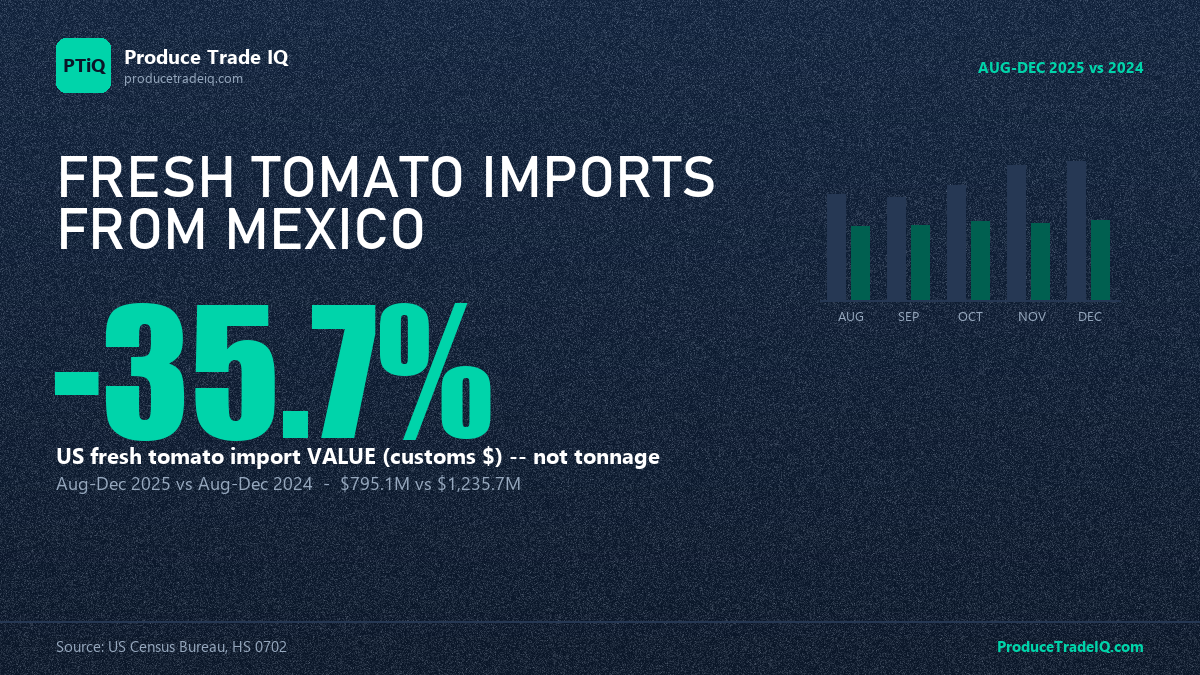
US Census data shows the value of fresh-tomato imports from Mexico fell 35.7% in the antidumping duty's first five months (Aug-Dec 2025 vs 2024). What that figure does — and doesn't — prove.
On July 14, 2025, the US Department of Commerce withdrew from the 2019 Tomato Suspension Agreement and issued an antidumping duty order on fresh tomatoes from Mexico. We pulled US Census Bureau monthly import statistics (HS 0702, tomatoes fresh or chilled, origin Mexico) to measure what happened to import value in the order's first five months.
The headline: the value of Mexican fresh-tomato imports for August-December 2025 was $795.1 million, down 35.7% from $1.24 billion in the same five months of 2024 ($795,099,962 of $1,235,711,438 = 64.3%, a $440.6M decline). That is a value figure — dollars, not tonnage — and the distinction carries the whole story. We get to it below.
What Changed on July 14, 2025
For most imports, the order set an antidumping duty of 17.09%, with company-specific rates ranging from 3.9% to 30.5% (Federal Register 90 FR 33363, July 17, 2025). It replaced the suspension-agreement framework that, in various forms since 1996, had set floor prices instead of collecting duties. Commerce's stated rationale was that the agreement failed to protect US growers from underpriced imports; the agreement was terminated and the underlying antidumping order put into effect.
The order is still in force in 2026. Commerce finalized a scope clarification on February 18, 2026 (fresh tomatoes destined for processing are excluded, subject to certification), and the US International Trade Commission instituted a changed-circumstances review on January 21, 2026. Neither revoked the order.
The stakes are large. Mexico supplies roughly two-thirds of US fresh tomatoes, and the trade is worth about $3 billion a year. The policy split the industry: Florida growers pushed for the duty, while many importers, distributors, and food-service buyers opposed it. We state that divide without taking a side — this post is about what the customs data shows, not whether the duty is good policy.
The Headline Figure: Import Value, Aug-Dec 2025 vs 2024
The number we summed is general imports, total value (Census field GEN_VAL_MO), origin Mexico, HS 0702. In this series the imports-for-consumption value is identical to the general-imports value, so there is no ambiguity between the two.
| Month | Value 2024 | Value 2025 | Change |
|---|---|---|---|
| Aug | $219.1M | $152.7M | -30.3% |
| Sep | $213.2M | $155.4M | -27.1% |
| Oct | $237.1M | $163.7M | -31.0% |
| Nov | $278.1M | $157.7M | -43.3% |
| Dec | $288.1M | $165.6M | -42.5% |
| Total | $1,235.7M | $795.1M | -35.7% |
The drop is real and it deepened through the autumn: November and December 2025 ran roughly 43% and 42% below their 2024 counterparts. But before reading that as the duty's fingerprint, look at the monthly trajectory.
The Monthly Trajectory Around July 14
Import value was already falling through the first half of 2025, well before the duty took effect — a mix of seasonal pattern and softer prices. Monthly value slid from $319.4M in January to $150.1M in July 2025. The duty did not start that decline.
What the duty window shows is the absence of the autumn rebound that occurred a year earlier. In 2024, monthly value climbed from $219.1M in August to $288.1M in December (+31%). In 2025 it stayed flat and low — $152.7M in August, $165.6M in December (+8%). The seasonal Q4 recovery simply did not happen in the order's first five months.
One thing the data does not show is front-loading. If importers had rushed shipments across the border ahead of July 14, we would expect a spike in May-June 2025; instead those months were already at seasonal lows ($197.3M and $175.8M). The monthly value series shows no pre-duty surge.
Into 2026: Did the Trend Continue?
Census coverage runs through February 2026. The depressed level persisted into the new year:
| Period | Jan-Feb Value | vs 2026 |
|---|---|---|
| Jan-Feb 2024 | $657.6M | 2026 is -40.5% |
| Jan-Feb 2025 | $555.6M | 2026 is -29.6% |
| Jan-Feb 2026 | $391.1M | — |
Early-2026 value of $391.1M was 29.6% below the same months of 2025 ($391,137,618 of $555,560,268 = 70.4%) and 40.5% below 2024. This is consistent with trade-press reports of a slower Mexican tomato season after the tariff (FreshPlaza, January 2026) — though, as below, the data here cannot establish cause.
The Honest Read: Value Is Not Volume
Here is the gap that makes this study worth reading carefully. The USDA projected only about a 5% decline in Mexican tomato exports — a volume measure — for 2025. We measured a 35.7% drop in value. Those are different metrics, and the difference is the point:
- Value = price × quantity. A drop in customs value can come from lower unit prices, lower volume, a shift in product mix toward cheaper tomatoes, or any combination. Census HS-level value alone cannot separate them.
- Weight and quantity are unavailable in this series. The tonnage fields for HS 0702 / Mexico are not populated in our dataset, so we make no claim about kilograms or price-per-kilogram. A 35.7% value decline is fully consistent with a much smaller volume change if unit prices also fell.
- Different windows. Our 35.7% covers the five duty months; USDA's ~5% was a full-year export projection. A five-month window can move far more sharply than an annual average.
- Correlation, not causation. These months follow the duty; the data does not prove the duty caused the change. Weather, the peso-dollar exchange rate, the size of Florida's domestic crop, and ordinary seasonality all move tomato value independently.
So what can customs value tell us? That the dollars US buyers sent to Mexico for fresh tomatoes fell sharply and stayed down through February 2026. What it cannot tell us is whether that means fewer tomatoes, cheaper tomatoes, or both.
What It Means for Produce Buyers
If you import or buy Mexican tomatoes, the duty is a real line-item cost — 17.09% for most shippers, more or less depending on your company-specific rate — and it has coincided with a sustained drop in import value. Whether your landed cost rises depends on your specific rate, your product mix, and whether the processing exclusion applies to your shipments.
The shifts worth watching from here: alternative sourcing origins, the processing-exclusion certification path, and where the ITC's changed-circumstances review lands. For the current roster of who is importing Mexican tomatoes and at what volumes — drawn from live CBP shipment records rather than monthly Census aggregates — see our Mexican tomato importers page.
Start your free trial on ProduceTradeIQ to monitor importers, shipment records, and FOB USDA prices as sourcing patterns shift under the duty — all in one platform. No credit card required.
Data source: US Census Bureau, International Trade monthly imports, HS 0702 (tomatoes, fresh or chilled), origin Mexico. Figure summed is general imports, total value (GEN_VAL_MO); the imports-for-consumption value is identical in this series. Tonnage/quantity fields are not populated for this series, so no volume or unit-price claims are made. Policy facts: US Commerce / International Trade Administration release (trade.gov, July 14, 2025); Federal Register 90 FR 33363. Analysis by ProduceTradeIQ.
See this data live on ProduceTradeIQ
Search any company, product, or trade route. 7-day free trial.
Start Free Trial